

Table of Contents
- FRANKENSTEIN: DOCTOR AND MONSTER
- FRANKENSTEIN ACCORDING TO THE UNIVERSAL
- FRANKENSTEIN ACCORDING TO HAMMER
- MARY SHELLEY'S FRANKENSTEIN (1994)
- OTHER FILMS RELATED TO FRANKENSTEIN
- Young Frankenstein/ Young Frankenstein (1974)
- Frankenstein Conquers The World (1965)
- The Rocky Horror Picture Show (1975)
- THE LEGACY OF THE MONSTER
Frankenstein or the modern Prometheus It is Mary Shelley's most popular work, but as is often the case, what made this horror story popular was not the novel itself, but the various film adaptations that arose from it.
![[Article] The many faces of Frankenstein](https://combogamer.com/wp-content/uploads/2014/03/frankenstein-book.jpg)
Unfortunately, as is the case with many books, these adaptations Not only did they not show the entire story, but they didn't even try to., they took the most basic concepts (the Doctor and the creature) and used them in different stories that had little to do with what was seen in Shelley's novel.
It is for this reason that if I say now that Frankenstein's monster is tremendously agile (able to climb mountains without any difficulty) and intelligent (able to speak, write and reason like anyone else) most readers will think "really?" And the creature that was brought to the cinema lacked these qualities in practically all the films, showing itself as a slow, clumsy character with little reason.
The same goes for the reason for his cruelty, the monster is not evil because of his brain (which in some films is that of a criminal) if not for the loneliness to which he is exposed due to his “living dead” condition, his terrible and deformed physical appearance that frightens those who see him and the lack of love, guardianship and understanding that his creator did not want to provide him.
FRANKENSTEIN: DOCTOR AND MONSTER
Although I guess everyone knows that Frankenstein is the doctor's last name that created the monster, and that the creature itself does not have any name of its own, I thought it would not hurt to comment on it now. This clarification is necessary because in many films the name Frankenstein has been used to refer to the monster and this can cause unnecessary confusion.
FRANKENSTEIN ACCORDING TO THE UNIVERSAL
![[Article] The many faces of Frankenstein](https://combogamer.com/wp-content/uploads/2014/03/1931-Frankenstein-Boris-Karloff-10-787x1024.jpg)
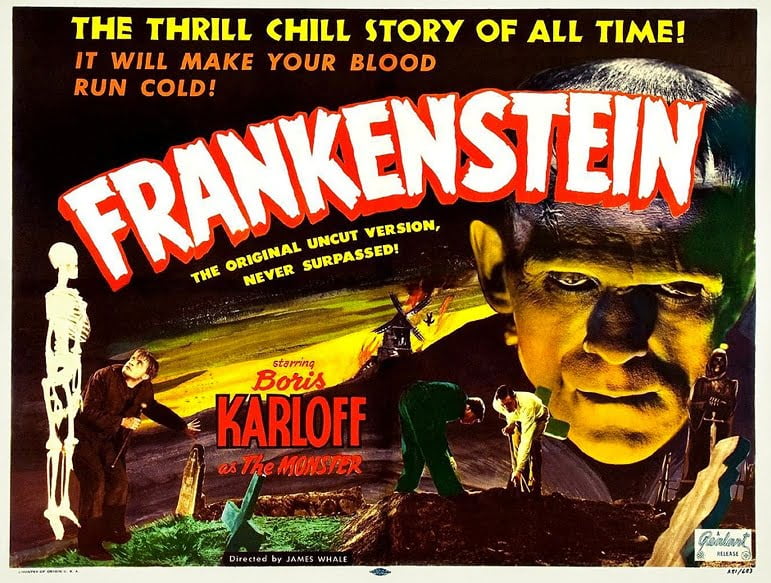
Universal's Frankenstein is generally considered the first Frankenstein of cinema. This name is totally misleading and false, since there are previous versions, such as the 1910 short film directed by J. Searle Dawley.
However, it cannot be denied that the Universal version was the one that catapulted the name of Frankenstein to fame, condemning all previous attempts to represent Shelley's work to oblivion.
Universal achieved enormous success with Dracula (1931) played by Bela Lugosi, an actor who enjoyed enormous fame for that role and became the emblem of the company at that time. In the following years, Universal continued to use monsters for its films, turning characters such as the Creature from the Black Lagoon and the Werewolf.
Frankenstein It was the company's second big hit in its "monstrous phase." The role was offered to Bela Lugosi, who turned it down because he didn't want to be covered in layers of makeup that would leave him unrecognizable, and he also didn't want to play a character who only growled. It was then that the role ended up in the hands of Boris Karloff, who brought us the most imitated and recognizable representation of the monster there has ever been.
The first movie called simply Frankenstein (1931) was loosely based on the book, taking only the most basic facts and putting them into a simple story that lasted about 60 minutes. Despite not representing the situations that occurred in the book, nor respecting the characters (even changing the name of some of the main ones) nor making a faithful representation of the monster (which was now slow, clumsy and not very intelligent) the film was a resounding success and sowed the seed from which practically all subsequent versions would germinate.
In Mary Shelley's work, things as important as the appearance of the monster (of which we only knew some details) or the process of its creation were ignored, so when making the film they had to invent the scenes that would pass down to posterity: the theft of corpses, the introduction of the brain, the way of transmitting the spark of life and the mythical phrase "It's alive! It's alive!" Of the famous Doctor Frankenstein upon seeing his completed work.
The film was a resounding success and had its first sequel with Bride of Frankenstein (1935) where it used and expanded a concept that appeared in the original book (the creation of a partner for the monster, so that it would stop being alone, and therefore being evil). This second film also represented the monster in a more reliable way, as he can finally speak and demonstrates that what really makes one evil is loneliness and cruelty, something that was thoroughly portrayed in Shelley's work.
![[Article] The many faces of Frankenstein](https://combogamer.com/wp-content/uploads/2014/03/Bride-of-Frankenstein-3-1024x789.jpg)
Despite the great ending of this film, the Frankenstein saga had another continuation a few years later. The Son of Frankenstein (1939) told us a totally original story that took place a few decades after the original film, and new characters were also introduced, such as Dr. Frankenstein's son or a former assistant of his father named Ygor (played by Bela Lugosi). This film closed the trilogy, and was the last time Boris Karloff played the monster.
![[Article] The many faces of Frankenstein](https://combogamer.com/wp-content/uploads/2014/03/Poster-Frankenstein-Meets-the-Wolf-Man_08-708x1024.jpg)
Despite the departure of the main star, the saga continued, with films like Ghost of Frankenstein (1942) where the insane Ygor intends to transplant his brain into the monster's body in order to be practically immortal or Frankenstein Meets the Wolf-Man (1943), a rather curious crossover between films, as it turns out to be a sequel to The Wolf-Man (1941) and the previous film, Ghost of Frankenstein (1942), as revealed by the fact that the monster is blind. In this film we see how Bela Lugosi finally plays the role he rejected years ago.
Tras esa película, los cruces entre personajes se volvieron una constante, dando como resultado películas tan particulares como house of frankenstein en 1944 (que fue conocida en España bajo el extraño pero acertado nombre de La Zíngara y los monstruos) either House of Dracula, al año siguiente. Esta masificación de monstruos era tremendamente llamativa, pero las películas se habían alejado tanto de su seriedad inicial que casi no sorprende que las últimas películas sean comedias como Abbot and Costello Meet Frankenstein en 1948.
FRANKENSTEIN ACCORDING TO HAMMER
Hammer Productions fue la sucesora espiritual de Universal en lo que se refiere a llevar a monstruos clásicos a la gran pantalla, pues la productora inglesa nos volvió a traer historias centradas en Drácula, la Momia o el monstruo de Frankenstein, con la novedad añadida de que eran películas a color.
En lo que refiere a Frankenstein, Hammer produjo un total de siete películas, con la particularidad de que estas están centradas en el doctor y no en la criatura, como pasaba con los films de Universal.
![[Article] The many faces of Frankenstein](https://combogamer.com/wp-content/uploads/2014/03/the-curse-of-frankenstein-600x342-1.png)
La primera película de esta etapa fue The Curse of Frankenstein en 1957, donde recurrieron al tándem formado por Peter Cushing (como Doctor Frankenstein) y Christopher Lee (como el monstruo). Esta pareja de actores son los más recordados de las películas de terror de la Hammer, ya que aparecieron juntos en muchas de ellas, interpretando Cushing al protagonista humano y Lee al malvado monstruo.
The Curse of Frankenstein nos narra la historia de la creación del monstruo a través de las palabras del propio Doctor, que se encuentra prisionero en una celda, a punto de ser condenado a muerte. La historia de la pelicula se vuelve a alejar de lo visto en la novela original, y el personaje del Doctor Frankenstein se muestra más decidido e implacable que nunca a terminar sus experimentos al precio que sea. El monstruo tiene un papel relativamente secundario, y su aspecto no tiene nada que ver con el icónico monstruo que interpretó Karloff, pues la Universal no lo permitió.
Un año más tarde llegó la secuela: The Revenge of Frankenstein, donde el Doctor evitaba su pena de muerte y continuaba con su terrible obsesión de llegar donde nadie ha llegado en lo que se refiere a la vida y la muerte, así como de reinventar la medicina moderna. Esta vez actuando en un hospital de pobres y bajo el nombre de Dr Stein.
En 1964 llega el tercer film del personaje, Evil of Frankenstein, que rompe la continuidad con los anteriores, pues nos vuelve a contar la historia de cómo el Doctor Frankenstein creó a su criatura, pero con muchísimas diferencias de lo visto en The Curse of Frankenstein, siendo una de las más notables que ahora el monstruo si se parece ligeramente al Frankenstein de la Universal, pues al parecer la película fue una especie de colaboración de ambas.
![[Article] The many faces of Frankenstein](https://combogamer.com/wp-content/uploads/2014/03/Frankenstein-Created-Woman-dvd-cover.jpg)
La saga continuó con películas que tomaban direcciones totalmente opuestas, como Frankenstein Created Woman (1964), donde se exploraban temas como el alma humana y su transferencia de un cuerpo a otro y Frankenstein Must Be Destroyed (1969) donde se recurría a experimentos similares a los vistos en las primeras películas, además de mostrar la evolución del Doctor que parece crecer en conocimientos y crueldad en proporciones iguales.
Y llegamos a Frankenstein And The Monster From Hell (1974), último film donde Cushing interpretará al doctor, que suma casi todo lo visto en las películas anteriores para darnos un film de atmósfera sucia y deprimente, donde Frankenstein practica experimentos con los pacientes de un psiquiátrico, para crear un ser humano definitivo al precio que sea. Como curiosidad decir, que en este film, la creación de Frankenstein está interpretada por David Prowse, actor que interpretaría años más tarde a Darth Vader en Star Wars, donde casualmente también aparecía Peter Cushing interpretando al Gobernador Tarkin.
Además de estos films, existe otro llamado The Horror of Frankenstein (1970) donde se vuelve a centrar la trama en la creación del monstruo, pero esta película no tiene relación directa con las anteriores.
MARY SHELLEY'S FRANKENSTEIN (1994)
![[Article] The many faces of Frankenstein](https://combogamer.com/wp-content/uploads/2014/03/mary-shelleys-frankenstein-movie-poster-1994-1020248424.jpg)
Cuando una película incluye el nombre del autor de la obra original en el título, significa que la historia tendrá que ver con el libro. O al menos eso es lo que pretendían hacer con esta película, donde el monstruo fue interpretado por Robert De Niro, hecho que ayudó a que el personaje transmitiese sus emociones al espectador mediante sus diálogos.
Aunque es indiscutible que esta película se basó en el libro de manera casi total, no se puede negar que hay una gran influencia de las películas de la Universal y la Hammer en ella, como el proceso de creación del monstruo o algunas de las sorpresas de la parte final del filme.
En cualquier caso, es una película muy recomendable para todos aquellos que quieran ver el libro llevado a la gran pantalla, o para los que no tengan ganas de leerlo y quieran ver alguna película que se parezca.
OTHER FILMS RELATED TO FRANKENSTEIN
Además de las citadas, hay muchísimas películas que se basan de una manera u otra en la historia escrita por Shelley. Tan alto es el número que me sería imposible enumerarlas todas, sin embargo me veo con la “obligación moral” de comentar brevemente las siguientes, que ofrecen una visión totalmente distinta del monstruo y su concepto.
Young Frankenstein/ Young Frankenstein (1974)
Esta divertida comedia dirigida por Mel Brooks es una parodia perfecta de las tres primeras películas que le dedicó la Universal al monstruo, hasta el punto de que se rodó en blanco y negro en homenaje a dichos largometrajes.
La historia narra como Fredderick Frankenstein viaja hasta la casa que ha heredado de su abuelo, donde continuará con los experimentos que marcaron negativamente el nombre de su familia en el pasado, con divertidas consecuencias.
![[Article] The many faces of Frankenstein](https://combogamer.com/wp-content/uploads/2014/03/Young-Frankenstein-2.png)
Frankenstein Conquers The World (1965)
![[Article] The many faces of Frankenstein](https://combogamer.com/wp-content/uploads/2014/03/frankenstein_conquers_the_world_poster.jpg)
Si lo miramos de manera general, no hay nada que conecte las películas japonesas de monstruos gigantes con la obra de Mary Shelley. Sin embargo, si nos ponemos a indagar un poco más nos encontraremos con conexiones casuales, como que algunas películas de Godzilla fueron renombradas en Alemania bajo el nombre de Frankenstein, y con otras conexiones no tan casuales, ya que en King Kong Vs. Godzilla (1962) se usaron algunos conceptos derivados de Frankenstein, como que King Kong se volviese más fuerte con la electricidad o que un rayo sea el responsable de su milagrosa recuperación (o resurrección) tras haber sido vencido por Godzilla.
Todas estas sutilezas quedaron en segundo plano cuando en 1965 Ishiro Honda llevó al cine la hilarante historia un monstruo de Frankenstein gigante, con dinosaurios y nazis de por medio. Toda una mezcla de conceptos que da como resultado una película extraña, pero entretenida.
The Rocky Horror Picture Show (1975)
Rocky Horror es un alocado musical que homenajea muchas películas de ciencia ficción y terror desde el primer minuto hasta el último. Su historia es la típica en la que una pareja de novios hacen un viaje y pinchan la rueda de su coche durante una tormenta, con lo cual se refugian en un castillo cercano, donde conocerán al Dr Frank N Furter (Tim Curry) que ha creado un monstruo de Frankenstein propio (que es un tipo rubio y cachas) con intenciones bastante… peculiares.
![[Article] The many faces of Frankenstein](https://combogamer.com/wp-content/uploads/2014/03/The-Rocky-Horror-Picture-Show-1024x592.jpg)
THE LEGACY OF THE MONSTER
Al igual que ha pasado con muchos personajes literarios, el monstruo de Frankenstein ha sido asimilado por la cultura del entretenimiento de manera total y absoluta, inspirando personajes para un sinfín de películas, videojuegos y cómics de la más diversa índole.
El monstruo de Frankenstein fue la semilla de la cual surgieron personajes como Herman Munster (The Munsters) Lurch (el mayordomo de la Familia Addams), Número 08 (dragon ball) Frank Frankenstone (En los Picapiedra), Franky (One Piece) FrankenCastle (la versión monstruosa de The Punisher) Hulk (cuyo aspecto original era muy similar al monstruo de la Universal) entre muchísimos otros personajes.
![[Article] The many faces of Frankenstein](https://combogamer.com/wp-content/uploads/2014/03/dragon-ball-numero-8.png)
Related Articles
![[HorrorScience] The man who could cheat death](https://combogamer.com/wp-content/uploads/2026/04/The-man-cheated-death-banner-300x165.png)
![[HorrorScience] Battle of the Giant Apes – War of Gargantuas (1966)](https://combogamer.com/wp-content/uploads/2026/05/War-of-Gargantuas-baner-horizontal-300x169.png)
![[HorrorScience] The Bride! –The Bride! (2026)](https://combogamer.com/wp-content/uploads/2026/03/The-Bride-banner-horizontal2-300x169.png)
![[HorrorScience] Cape Fear – Cape Fear (1991)](https://combogamer.com/wp-content/uploads/2026/01/El-cabo-del-miedo-4-300x169.jpg)
![[HorrorScience] Godzilla Minus One (2023)](https://combogamer.com/wp-content/uploads/2024/08/Godzilla-Minus-One-banner-300x138.jpg)
![[HorrorScience] Godzilla: Planet of the Monsters (2017)](https://combogamer.com/wp-content/uploads/2020/11/Godzilla-NETFLIX-1-cartel-300x150.png)