
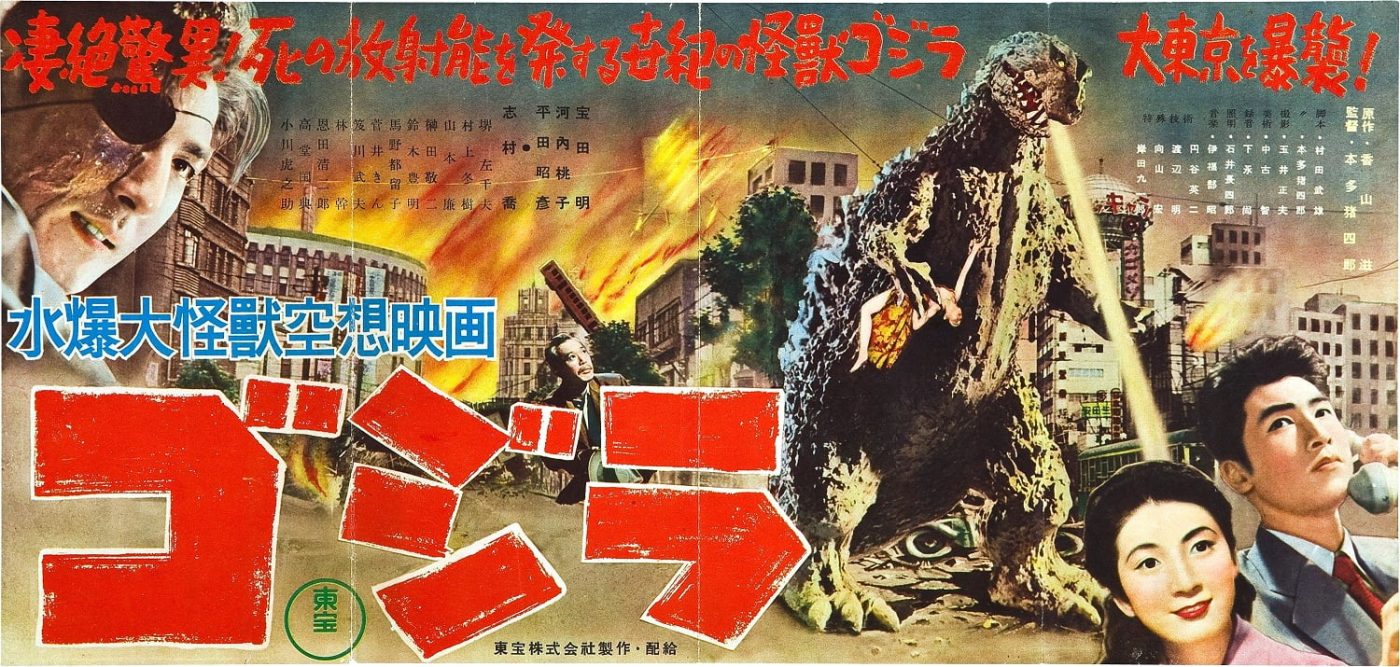

Godzilla has earned his reputation as one of the most famous giant monsters in cinema, as He has starred in thirty films, in which the original idea of the monster has been modified according to the time and the demands of the public, with very variable results as I already mentioned in this article, where I talk about his entire career, which began 60 years ago.
On this occasion I am going to talk about the film that saw him born, called simply by the Japanese name of the monster, gojira, and renowned in Spain under the very long title of Japan under the terror of the monster.
It is worth clarifying that this analysis focuses on the Japanese version of the film and not the modified one, since When this film arrived in the United States, footage was cut, dramatic scenes were removed, new scenes were added (starring Raymon Burr who plays a journalist who witnesses Godzilla's attack) and almost all references to atomic bombs were censored, thus removing the critical and anti-war message of the original film. This version was renamed at the time as Godzilla: King of the Monsters, and many years later the unmodified version could also be obtained in American territory.
The film begins by showing us how a ship mysteriously disappears after sending a distress signal, and how a rescue ship is sent and then disappears in the same area, causing uncertainty among those responsible for the rescue.
At the same time we are shown some fishermen who discover that the fish have practically disappeared from the sea, which leads an old fisherman to suggest that the responsible is a monster from an ancient legend, Gojira (Godzilla in the West).
Added to this is an earthquake in a small town in Japan that leaves houses crushed, water contaminated by radiation, and few survivors who say they have seen a giant monster. Dr. Yamane will be sent to the place to investigate what has happened and, after finding evidence, he explains that Godzilla is a prehistoric monster that was displaced from its habitat due to hydrogen bombs that were launched in the Pacific.
![[HorrorScience] Gojira – Godzilla: King of the Monsters (1954)](https://combogamer.com/wp-content/uploads/2014/06/GODZILLA-54-tren.jpg)

Having assumed that the monster is real, and after deciding that news like that cannot be hidden from the population, Japan launches its first attack by bombing the areas of the sea where Godzilla is supposed to be while looking for other alternatives to eliminate him.
One of those alternatives are the experiments of the secretive Dr. Serizawa, who refuses to talk about them with journalists, but shows them to Dr. Yamane's daughter. Dr. Serizawa mistakenly discovered a way to remove oxygen from creatures in the water, resulting in the destruction of those affected. Due to his fear that this discovery will provoke a new war, he decides to keep the “Oxygen Destroyer” a secret at any cost.
![[HorrorScience] Gojira – Godzilla: King of the Monsters (1954)](https://combogamer.com/wp-content/uploads/2014/06/GODZILLA-54-Serizawa.jpg)

However, Godzilla's attacks continue to happen, all human security measures are useless, and after the passage of the gigantic monster only destruction remains, cities in flames and few survivors, most of them sick from radiation. giving some of the most dramatic scenes in the film, where people are seen in hospitals dying before the helpless gaze of doctors and relatives (in a clear reference to what Japan experienced after the bombs of Hiroshima and Nagasaki).
Godzilla appears to be completely immune to the army's attacks and displays an incredible ability to destroy everything he encounters. The only thing Japanese citizens can do is pray for it all to end, at which point Dr. Serizawa will have to make the decision to expose his Oxygen Destroyer to the world, a weapon that if it falls into the wrong hands could lead to the end of humanity.
![[HorrorScience] Gojira – Godzilla: King of the Monsters (1954)](https://combogamer.com/wp-content/uploads/2014/06/GODZILLA-54-gente.jpg)

And that is the summary of the first Godzilla film, a totally unique film within its saga, as it is tremendously dramatic and very explicit in the scenes of destruction and its consequences, to the point that Godzilla only appears continuously in the final part of the film, since the rest of the scenes are based on how humans suffer the consequences of it.
When it comes to the technical section, Eiji Tsuburaya did a great job with the special effects. It is true that In some scenes you can see the artificiality of Godzilla (especially in those where a kind of doll is used to represent it) but in most cases, the special effects look very good, surely protected by the black and white of the film, which contrasts the bright explosions of the city with the dark silhouette of Godzilla.
In the musical field, Akira Ifukube introduces two themes that will be key in the saga: the threatening Godzilla theme (which conveys greater drama to the destruction) and the lively army theme (which would be modified and reused in later films).
![[HorrorScience] Gojira – Godzilla: King of the Monsters (1954)](https://combogamer.com/wp-content/uploads/2014/06/GODZILLA-54-ciudad-1024x576.jpg)

I would like to say that everything is good in this film but it is not like that, the Japanese cinema of the 50s is not particularly fast and This movie, despite not being too long, has a fairly slow overall development which can make it heavy.
Even though gojira It was a controversial film for recalling the horror that Japan experienced after the then recent Second World War, it turned out to be a success with the public and received many praises, winning an award for best special effects and losing the award for best film against another masterpiece of Japanese cinema: The seven samurai by Akira Kurosawa.
Three curious facts:
- The name Gojira came from combining Gorilla with Kujira (whale in Japanese).
- Se suele considerar a esta película como la que dio origen al genero de monstruos gigantes (Kaiju Eiga) en Japón.
- El actor que se disfrazó de Godzilla (Haruo Nakajima) perdió 10 kilos de peso y sufrió dolencias musculares a raíz del calor y peso del traje. Pese a ello siguió interpretando a Godzilla durante más de 20 años.
Related Articles
![[HorrorScience] Obsession: turning the classic "be careful what you wish for" into a nightmare](https://combogamer.com/wp-content/uploads/2026/07/obsession-poster-300x169.jpg)
![[HorrorScience] Backrooms: the A24 film that turned an internet creepypasta into a horror phenomenon](https://combogamer.com/wp-content/uploads/2026/07/backrooms-poster-300x169.jpg)
![[HorrorScience] Victor Crowley (Hatchet IV): The fourth installment that arrived without warning](https://combogamer.com/wp-content/uploads/2026/06/victor_crowley-poster-300x169.jpg)
![[HorrorScience] Number 23 (2007)](https://combogamer.com/wp-content/uploads/2026/05/El-numero-23-banner-largo-300x169.jpg)
![[HorrorScience] Hokum: When a bitter writer meets an Irish witch](https://combogamer.com/wp-content/uploads/2026/06/hokum-poster-300x169.jpg)
![[HorrorScience] The man who could cheat death](https://combogamer.com/wp-content/uploads/2026/04/The-man-cheated-death-banner-300x165.png)