


Between November 21 and 23, 2014, the Getxo Comic Fair. In its fifteenth edition we were able to enjoy talks, signing sessions, sales stands, or exhibitions such as the one we were able to see to commemorate the 50 years of Mafalda.
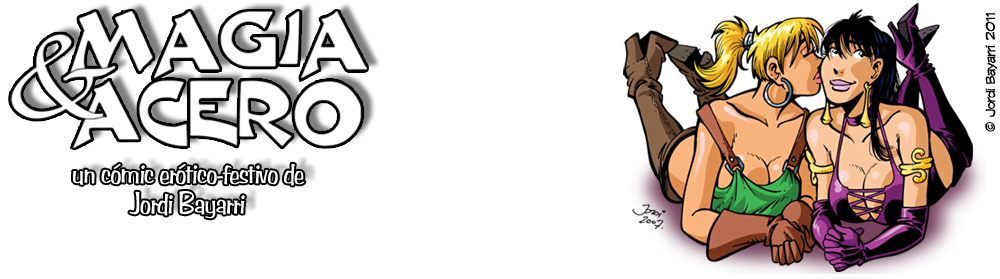
We took the opportunity to chat for a while with a national author known in part because many of his works are self-published and for being a great defender of this practice, Jordi Bayarri: Valencian author with a degree in Fine Arts and creator of a good number of fantastic comics such as Between Darkness, Titan of the Past and Dragon Skin. EITHER Alien College, which tells the story of three sisters who live in a boarding school and are the earth's only defense against an alien invasion. Others of an erotic nature such as Enchantae either Scrap Trek, and perhaps his best-known work: Magic & Steel, which mixes his two favorite genres, medieval fantasy and erotica.
But this is not the only thing Jordi focuses on. we can find Staple!, a proposal for an affordable format that provides the reader with simple format comics at a reduced price. Wave Scientific Collection with an informative and cultural nature that will tell us in different volumes focused on great historical figures part of their biography. Without further ado, let's get to the interview:
Regarding self-publishing, what were the reasons for considering this and starting with it?
On the one hand, for convenience. Most of the time I do everything and I know how it has to turn out so that I like it. To give an example: if in a project I am in charge of the drawing, I don't have to worry about whether the scriptwriter likes the placement of the vignettes or the speech bubbles. But it is true that if the budget allows it, I have sometimes used a colleague in the sector to take charge of the color or something similar, as has been the case in Marie Curie. But above all, being able to publish whatever I want was one of the compelling reasons for considering self-publishing. That independence of not having to convince anyone to publish it for me, nor having to consult anyone.
It is clear that this independence is a pro very important. But as always, there has to be some cons. What would they be?
Well yes, like everything, this also has its cons. Especially since you are the one who has to do everything. It is much more work than if you only have to deal with the script or the drawing. In addition to this you have to take care of the whole issue of management and going to the printer. It's not very artistic, let's say. It is more administrative, which often makes it a bit tedious.
But hey, I consider it the price to pay. And precisely all that extra work, I believe, is what puts many authors back the most when it comes to launching into self-editing.
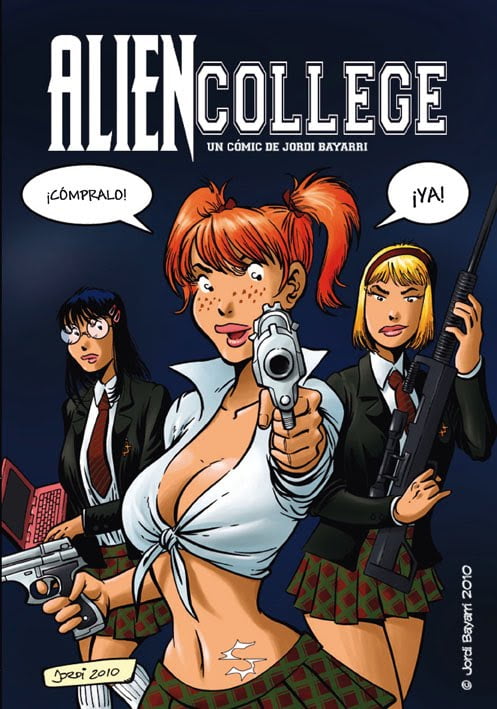
We can find multiple works of yours on the internet. Alien College that you publish periodically and free of charge on your website, or Enchantae , under monthly subscription. Does the digital format facilitate self-publishing?
In the case of Alien College I upload the pages like any other website or blog. In the case of Enchantae It's not very different. Since it is paid, there is an external company that is in charge of managing customer data and so on, but in the end it is another way to get the work directly to the reader.
The truth is that in my case it's going well, but I'm trying to finish now, because I've been working on a couple of new websites in the same style as Enchantae, but with other authors. I will play the role of a kind of “digital editor”, although when everything is more tied up we will announce it. It is a format that I still like a lot.
How does the general public accept the digital format?
One thing does not eliminate the other. The two formats can coexist without problems. There are webcomics that then go to paper, or vice versa, and many people read both formats. It is simply another option to publish.
In your case, you also publish Echantae in English. Is it worth the time spent on translations, labeling, etc.?
Actually Enchantae It is published in English, because it is more oriented to the American public and by the way, I also publish it in Spanish. But it really doesn't require much extra work, since regardless of the fact that this genre is not talked about much, there are no big changes to make apart from the translation. What you achieve with that detail is to expand the audience a little in other countries.
Changing the subject a little, and entering with your Scientific Collection, ¿Qué es lo que te llevó a comenzar con este proyecto?
Fue un conjunto de cosas. Antes en los salones veía que la media de edad de la gente iba desde los 30 a los 40 años la mayoría de las veces. Pero ahora esos lectores han tenido niños. Y esos niños han crecido. Es entonces cuando el padre piensa: “Voy a comprarle un tebeo al niño”. Ese cambio se ve mucho actualmente en los salones y a mi me gustaba la idea de hacer algo para chavales, pero no sabía el qué, ya que yo seguía con mis historias de fantasía o eróticas.
Entonces me llegó un encargo de la entidad valenciana Consell Valenciá de Cultura que querían celebrar el bicentenario de Darwin con un pequeño tebeo biográfico. Entonces fue cuando dije: “¡Esto mola! Ya me han dado una idea para hacer algo orientado a los chavales y además con carácter educativo”. Cuando vi que había interés en el proyecto, fue cuando seguí con ello.
Hasta la fecha tenemos a Darwin, pasando por Galileo and Newton hasta llegar a la reciente Marie Curie. ¿Alguna pista de por dónde va a seguir la colección?
Ramón y Cajal. Según publicamos Newton ya empezaron a decirme que tocaba una mujer. Y les dije que Marie Curie ya estaba en proceso. Creo que ya tocaba algo nacional.
Después de esto hay que mirar por dónde tirar. Puede que Einstein, o mirar más atrás en la historia.
![[Interview] Jordi Bayarri](https://combogamer.com/wp-content/uploads/2024/10/coleccion_cientificos_jordi_bayarri01.jpg)
Esta colección está saliendo adelante gracias a plataformas de crowdfunding. ¿Cual es la opinión dentro del sector acerca de este método?
Muchos tienen una opinión equivocada porque creen que el crowdfunding es una varita mágica. Piensan que si no hay ninguna editorial que quiera publicar su trabajo, va a poder tirar de esto y ya tiene su tebeo publicado. Como si eso te solucionase todo. Realmente solo soluciona el problema de “la pasta”, ya que todo el resto del trabajo hay que hacerlo igual. Además, llevar una campaña de crowdfunding con éxito es un trabajo extra y no es facil tampoco. La promoción para que la gente se anime a apoyar el proyecto tiene que ser continua. Y una vez el tebeo está hecho, hay que dedicarlos, preparar los sobres con la dirección de todos los que hayan apoyado, y hacer los envíos que es un trabajo bastante tedioso.
¿Qué es Staple!? ¿Cómo lo definirías?
Podríamos decir que es una especie de editorial. Si el proyecto de un autor me gusta, adelante con ello. Sobre todo, lo que te comentaba al principio. Aquellos que no se atreven a autoeditarse o no saben muy bien como hacerlo, lo sacamos en Staple! y ya me encargo yo del papeleo de editor.
En cuanto a cómo lo definiría… Digamos que Staple! es un poco intentar ir a contracorriente del mercado en general. Actualmente se ha quedado un poco estancado en un tipo de producto muy concreto, que es este tomo de 200 páginas, que vale mucho dinero. Que está bien y una cosa no quita la otra, pero hemos dejado de trabajar otros formatos que también convienen. A mucha gente le gusta sentarse un rato y leer algo ligero, que pueda terminar en ese momento.
Y también un poco de cara a los autores. Que no vayas a una editora con una obra de 70 a 100 páginas y te diga que necesita otras 100, porque no da para llenar un tomo. Es un poco intentar ayudar al lector para que siga leyendo, y ayudar a su vez al autor a hacer cosas un poco más ligeras y más a su rollo.
Empezasteis con tu #haciendotebeos y con Los otros Superhéroes de Jose Fonollosa. Se han ido sumando más autores a las publicaciones. ¿Ha tenido buena aceptación el proyecto?
Curiosamente varios autores que se han unido, vienen de hacer este tipo de trabajos que comentábamos. Unos tebeos muy largos, muy serios y ese no es el rollo que llevábamos. Al final en los salones y demás, hay alguno que te comenta algo, o siempre conoces autores a los que les van este tipo de cosas. En general ha tenido bastante buena aceptación, es más, ahora en diciembre sacamos El Julian de Gol y Pedro Camello. para el año que viene estamos preparando cosas muy chulas que hasta que no estén más cerradas, no podemos decir nada.
Ha sido un placer Jordi. Espero que todo el que lea la entrevista, se anime a echarle un vistazo a tu trabajo.
Gracias a vosotros. Cualquier cosa que necesitéis, ya sabes dónde encontrarme.
Preguntas extra:
¿Cual ha sido el tebeo que más te ha marcado, o tu favorito?
Hay un album de Spirou y Fantasio que se llama QRN sur Bretzerlburg que fue el primero que me compré cuando era muy pequeño. Mis hermanos son mayores que yo y han leído tebeos desde mucho antes que yo. Ya teníamos Asterix, ya teníamos Tintin y creí que ya era era hora de comprar algo de otra serie. Según lo leí, me dije a mi mismo: “¡Esto es la hostia!”. Y por eso creo que ese es el que más me marcó y lo puedo considerar uno de mis favoritos.
¿Con qué género te sientes más cómodo dibujando?
Sin duda con el género erótico. Me gusta mucho dibujarlo.
¿Qué personaje/s disfrutas más dibujando?
¡Uff! Es que todos son mis hijos, los quiero a todos por igual. Creo que Ashla e Ihana, las chicas de Magic & Steel. Es de estos personajes con los que no tengo ni que pensar y siempre me apetece volver a dibujarlas. Además que les guardo mucho cariño porque empecé con ellas hace muchos años y con las que he aprendido mucho.
Podéis adquirir las obras de Jordi y las novedades de Staple! in Anillo de Sirio.
Related Articles
![[Review] Planeta Manga and MANGA ISSHO: Spanish and European manga magazines](https://combogamer.com/wp-content/uploads/2026/06/Planeta-Manga-ISSHO-manga-300x169.png)
![[Reseña] Mazinger-Z: El robot de las estrellas – La historieta española que mejoró el bodrio taiwanés en el que se basaba](https://combogamer.com/wp-content/uploads/2025/08/Mazinger-Z-el-robot-de-las-estrellas-300x198.png)
![[Article] The "comics of the year" (2024 special)](https://combogamer.com/wp-content/uploads/2025/01/Los-comics-del-ano-2024-1-300x169.jpg)
![[Review] Brian the Brain Integral](https://combogamer.com/wp-content/uploads/2024/11/Brian-the-Brain-Integral-Resena-300x179.png)
![[Muy Top] Cinco novelas gráficas de Paco Roca](https://combogamer.com/wp-content/uploads/2024/09/Muy-Top-Paco-Roca-Portada-300x248.jpg)
![[Meeting…] The mad scientist of 13 Rúe del Percebe](https://combogamer.com/wp-content/uploads/2024/10/Conociendo-a-Cientifico-loco-de-13-Rue-del-Percebe-300x146.png)