


Table of Contents
There are games that you finish and leave you with a feeling of having experienced a wonder, and Mixtape falls squarely into that category. The new work by Beethoven & Dinosaur, the studio behind The Artful Escape, is one of those rarities that makes a list of songs, a handful of well-written characters and just a couple of hours long outweigh productions ten times larger. Having played it from start to finish, I can honestly say that it is full of magical moments, the kind that stay in your head long after you see the credits.
What it's about: one last night before growing up
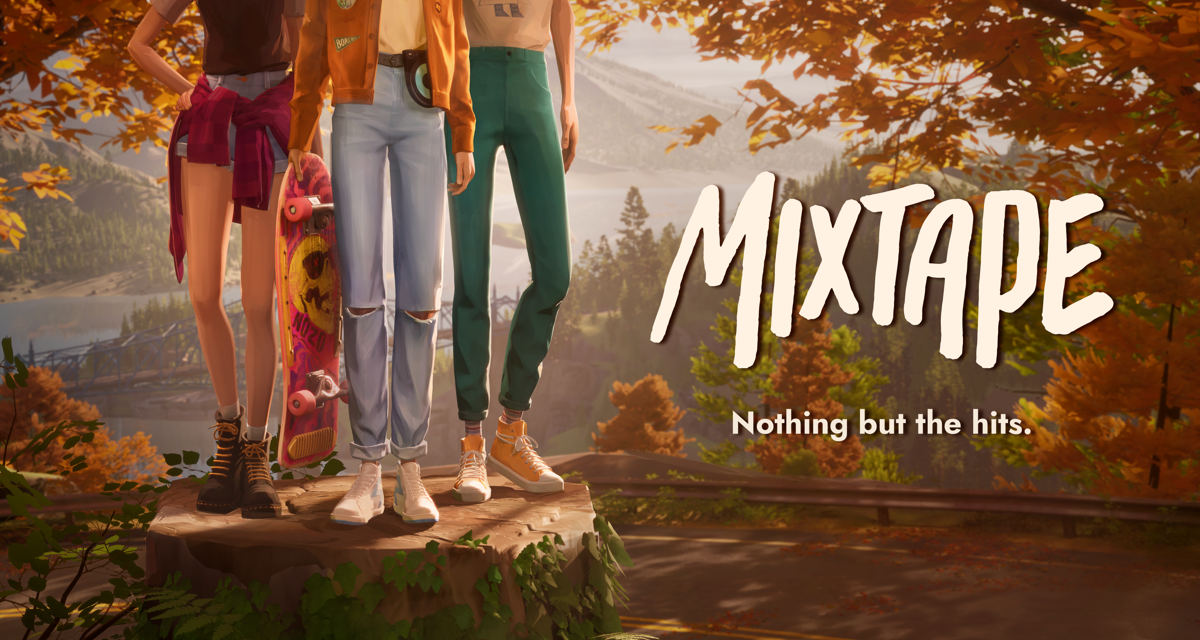
Mixtape puts us in the shoes of Stacy Rockford, a music-obsessed teenager who dreams of moving to New York to become a music supervisor. Next to her are Van Slater, the free and creative soul of the trio, and Cassandra Morino, the most rebellious of the three and the one who least wants it all to end. The story takes place almost entirely during a single day in the late 90s: the last that the three will spend together before adult life separates them (forever?), while they prepare for one last party that functions as a symbolic closure of adolescence.
What's interesting is how the game tells this story. Instead of moving forward linearly, Mixtape constantly jumps between the present of that last night and memories of the past that are activated by interacting with specific objects: a photo, a dusty trophy, a crumpled note, or a conversation. Each of these objects triggers a playable vignette that shows us a different fragment of the relationship between the three protagonists, and it is through this accumulation of small moments, rather than a large plot with unexpected twists, that the game builds the bond between them and with whoever is on the other side of the control. It is not a particularly complex story, but it is so well managed that it does not need to be: each silence, each gesture and each song that plays at the right moment ends up weighing much more than one would expect.
How to play: small scenes, big sensations
This is where Mixtape generates the most discussion, and I understand why. It is not a game that relies on a central system of mechanics that is repeated and deepened throughout the game, as occurs in most traditional narrative adventures. Instead, it proposes a succession of very different playable sequences, each one designed to accompany a song and a specific emotion. In some sections you ride a skateboard doing tricks around the city, in others you play baseball in a vacant lot, and there is a chase in supermarket carts that is directly reminiscent of the type of chaotic sequences typical of teen cinema from the 80s and 90s. There are also much more strange and personal moments: an awkward scene in which both tongues are literally controlled during a first kiss, another in which the camera distorts while guiding a rather agitated Van through a video store, and a third in which we walk through an abandoned amusement park stepping on everything in our path, almost as if we were akaijupocket.
None of these sequences last very long nor are they intended to be a serious mechanical challenge. Control always takes a backseat to the sensation you seek to convey, and that is the key to enjoying the game: if you go in expecting deep systems and difficulty curves, it is easy to leave disappointed, because Mixtape is not designed for that. What it does achieve, and it achieves it with a solvency that few narrative games achieve, is that each of those vignettes feels like a beautiful piece of scenery within a larger whole, without the general rhythm suffering. There are stretches of sharper action and completely contemplative stretches, like simply walking and chatting next to a secluded lake throwing stones into the water, and the game transitions from one to the next without the seam being noticeable.
Music as the true driving force of the game
If there is something that separates Mixtape from the rest of the narrative adventures, it is the role played by the soundtrack. It's not a simple accompaniment: each scene is anchored to a specific song, supposedly chosen by Stacy herself, and that song determines the rhythm, tone, and even the visual palette of the moment being played. The musical selection includes songs by bands like Devo, Smashing Pumpkins, Iggy Pop and Joy Division, among many others, and the game uses them with a precision that is rarely seen in the medium: not as background music, but as another narrative element, on the same level as the script or the characters' performances.
The artistic section accompanies this idea with a very particular direction: hand-drawn animations, a reduced frame rate that gives it an almost comic-book-in-motion feel, and sequences that combine these graphics with images filmed in the style of MTV video clips of the time. The result is an aesthetic that works almost like a time capsule, designed for those who lived through those years but perfectly enjoyable for those who did not, in the same way that series set in that decade manage to transmit that nostalgia to generations that did not know it firsthand.
References and influences: John Hughes, Journey and the weight of growing up
It is impossible to talk about Mixtape without mentioning the cinema of John Hughes as a central reference. The structure of “one day, one city, three incredibly well-written protagonists” draws directly from films such as The Breakfast Club, Sixteen Candles or Ferris Bueller's Day Off, and the development team itself openly recognizes it as a starting point. You can also trace the influence of another classic of thecoming of ageteenager and its urban chases, as well as a certain more hooligan spirit that is reminiscent of the independent teen comedies of the 90s.
At a playable level, the comparison that convinces me the most is with Journey. Not because they are mechanically similar, but because both games aim to generate a very specific emotional experience in a relatively short time, prioritizing sensation over any system. There are also echoes of Life is Strange in the way it treats memories and relationships between teenagers, although Mixtape deliberately distances itself from the choices and ramifications that characterize this type of game: here there are no decisions that change the course of the story, because the objective was never to offer different endings but to tell this specific story in the best possible way.
My impressions
I completely understand why Mixtape generated so much discussion. It is a short game, with playable sections that will seem scarce to more than one, and with protagonists who at first may not seem likeable: three well-off teenagers whose biggest problem is getting alcohol for a party. But for me that's exactly part of the fun: the game doesn't need grandiose dramas to excite, because it builds these characters with such care, and accompanies them with such an accurate musical selection, that I ended up becoming attached to all three much sooner than I expected.
There are specific scenes that stayed with me in a way that few games achieve: the moment in which the right song starts playing while you are going downhill on a skateboard, the mix of humor and melancholy of the abandoned amusement park sequence, or that closing that makes a classic eighties song end up working as the perfect farewell to this story. It is not a game for everyone, and I understand that, but for those who enjoy narrative adventures that prioritize atmosphere and emotion over mechanical complexity, Mixtape is one of those experiences that is appreciated precisely for its honesty and lack of pretensions. Rarely does such a short game leave such a great feeling when you finish it.
Related Articles
![[Analysis] Scholar Adventure: Mystery of Silence — A Journey to an Abbey that Whispers Secrets](https://combogamer.com/wp-content/uploads/2026/06/Scholar-Adventure-Mystery-of-Silence_poster-300x169.png)
![[Analysis] OUTBLAST — When 2000s Arcade Puts on the VR Goggles (and Still Unimpressed)](https://combogamer.com/wp-content/uploads/2026/06/OUTBLAST-poster-300x172.jpg)
![[Analysis] NODE: The Last Favor of the Antarii — Program Every Leap to Save the World](https://combogamer.com/wp-content/uploads/2026/06/NODE-poster-300x169.jpeg)
![[Analysis] Echo Generation 2 — When a Sequel Risks Everything](https://combogamer.com/wp-content/uploads/2026/06/Echo-Generation-2-poster-300x169.jpg)
![[Analysis] Swan Song — The Last Melody of a Father Who Built a Music Box to Not Face Death](https://combogamer.com/wp-content/uploads/2026/06/swan_song-poster-300x169.jpg)