


Table of Contents
Surely many of you have heard at some point about Arabian Nights, that famous written compilation of stories from the medieval Islamic tradition that, like all popular stories, until then had been transmitted orally. The world that these portray to us is imbued with magic and fantasy, and since its first translation into French in the 18th century, and especially since the 19th century, in the heat of European colonial expansionism, it also left a deep mark on the Western imagination. The great person responsible for its popularity in the most immediate moment is the film Aladdin (1992) by Disney, although in the field of video games we should not detract from Prince of Persia (1989). Both titles have several affinities, such as the geographical location (Middle East), the magical elements, the love between a hard-working hero and a princess and, above all, the figure of a evil vizier as the main antagonist, called in both cases Jaffar.
These did nothing more than collect the black legend (which, like all legends, has some truth, as certain historical examples attest) of a cruel and ruthless prime minister, who, especially since the Abbasid Caliphate (750-1258), was gaining increasingly more absolute powers, acting as the executive arm of a sovereign increasingly reduced to a decorative figure with mere religious authority. However, there is a precedent well before these two perfidious characters, and which also has the peculiarity of being the very protagonist of the story. I speak, of course, of Iznogud (1962), of Rene Goscinny (who was also the screenwriter of Asterix and Obelix) and Jean Tabary.
BEING CALIFH IN PLACE OF THE CALIFH
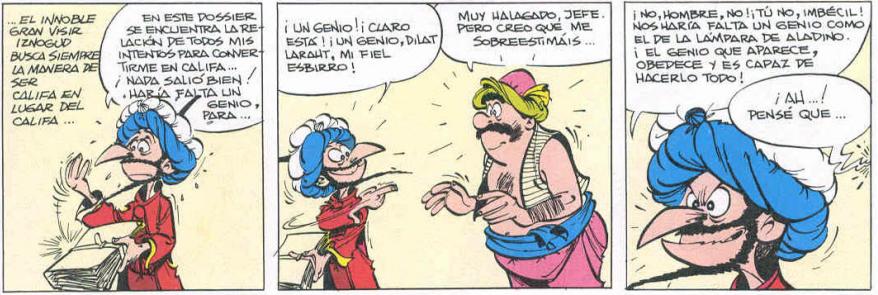
Iznogud is a little man of five feet tall, with a long, pointed nose and a narrow beard. and no less sharp and prominent than it bears the title of vizier of the Caliphate of Baghdad. His own name, a play on the English phrase "he's no good", to which we must add the sullen, devious and malicious expression, leaves no room for doubt about his moral character. These stylistic characteristics, typical of the Franco-Belgian school (which, as we saw, would also leave a vivid imprint on the bruguera school) will become more pronounced over time, while acquiring a growing personality.
![[Meeting…] Iznogud](https://combogamer.com/wp-content/uploads/2016/06/Iznogud-y-el-califa.jpg)
In the mind of the abject and ambitious vizier there is only one thought: to be “caliph instead of the Caliph” (the highest political and religious authority in the Muslim world), a phrase that he will repeat like a mantra in each chapter, and especially at the beginning of it, while he ponders, wandering visibly agitated, looking for the best way to achieve it. This caliph whom he wants to usurp the throne is Harun el Pussah, whose name is inspired by the historical caliph Harun al-Rashid (766-809), very recurrent in the stories of The Thousand and One Nights, and which would come to mean "dumbass." In fact, although the “commendator of believers” is a just, pious and full of goodness person, and for this unanimously acclaimed by all the people of Baghdad, He is so stupid that he is unable to see the plots that his grand vizier, whom he naively calls “my good Iznogud,” is constantly plotting against him. Although it is an open secret throughout the city, the good and plump caliph disdains them, calling them “gossip” and “nonsense,” while he spends most of the day sleeping on his gigantic pillow.

The most paradoxical of all is the fact that the evil Iznogud stumbles upon (almost always by pure chance) a important repertoire of magical elements that could be extremely useful to fulfill your purposes, from beings with supernatural powers such as magicians and geniuses until various artifacts such as flying carpets, magic slippers (instead of the famous magic genie lamp), hats, magic puzzles, diamonds of misfortune and even a magic camera, among many others. None of that will work since Each and every one of his fruitless attempts will culminate in great misfortune for the unfortunate vizier.. Other more mundane tricks have no effect either, and when he tries to redirect the wrath of the fearsome Sultan Pullmankar (apparently, something like “tram” in English), he will be the one he ends up punishing. It is not surprising that his faithful servant Dilá Lará (“se dilater la rase”, that is, “have a good laugh” in French) intente disuadirle en vano, avisándole de que es perfectamente previsible que sus planes terminen en el fracaso más estrepitoso.
![[Meeting…] Iznogud](https://combogamer.com/wp-content/uploads/2016/06/Iznogud-y-Dila.jpg)
IZNOGUD THE INFAMOUS
Como ya se ha dicho, Iznogud es es personaje taimado, abyecto y ambicioso, a lo que hay que añadir su carácter egoísta y avaro. En resumen, reúnen todas las características para que podamos considerarlo el antihéroe por antonomasia. Las leyes promulgadas por él mismo incluyen torturas terribles, empalamientos (los cuales también son una amenaza habitual cuando alguien no hace lo que él ordena), además de otroscastigos arbitrarios. Es un ser mezquino que detesta la alegría y la bondad. La felicidad ajena le produce melancolía, mientras que las desgracias de los demás le animan y le hacen reír. Su naturaleza inmisericorde también se ceba con Dilá Dará a quien utiliza como conejillo de indias para comprobar si los artefactos mágicos surten efecto.

En cuanto a su avaricia, basta con mencionar los impuestos que exige a los contribuyentes de Bagdad, extremadamente onerosos, cuyo único fin parece ser únicamente el de saciar su codicia. Ello se hace igualmente patente en el hecho de que es un regateador implacable, capaz de conseguir el mejor precio de cualquier prodigio que los mercaderes sacan a la venta. Por lo tanto, no es de extrañar que el pueblo entero procese hacia él un odio visceral y que en cierta ocasión (en concreto en Iznogud, al fin califa, tomo 20), cuando llevó a cabo un sondeo de opinión, todos los ciudadanos deseaban para él una muerte violenta.
![[Meeting…] Iznogud](https://combogamer.com/wp-content/uploads/2016/06/Iznogud-neoliberal.jpg)
Eso sí, como curiosidad, cabe destacar que en La infancia de Iznogud (#15, 1981) se muestra que no siempre fue así. Por el contrario, era un niño bondadoso, generoso y honesto. Aunque no voy a rebelar el secreto de semejante metamorfosis, sí adelantaré que tiene un origen sobrenatural. Otra es que, en Las pesadillas de Iznogud aparecen dos de sus hijos, Izverybad e Izveryfea, pero como spin-off que es, no ha tenido transcendencia posterior. También tiene un padre que, por lo que se ve el la portada de De Padre a hijo (#30), parece tan malvado como él, aunque al estar inédito en español, aún no sabemos más.
![[Meeting…] Iznogud](https://combogamer.com/wp-content/uploads/2016/06/Iznogud-hijo.jpg)
![[Meeting…] Iznogud](https://combogamer.com/wp-content/uploads/2016/06/Iznogud-de-padre-a-hijo.jpg)
CONCLUSION AND RECOMMENDATIONS
Iznogud es el malvado visir que toda historia ambientada en el mundo de Las mil y una noches parece tener por decreto. Su mezquindad, codicia y su ambición desmedida hace que sea odiado por todos, salvo por un bondadoso y bobalicón califa al que, paradógicamernte, quiere destronar. Sus continuos fracasos, a cada cual más desgraciado que el anterior, llevan al lector a la extraña sensación de sentir lástima por él y de desear (al menos en parte) que alguna vez le salga algo bien.
La serie Iznogud cuenta con 30 volúmenes de los cuales 27 han sido traducidos al español. Dentro de esta, hay tres partes claramente diferenciadas. Los catorce primeros, compuestos por historietas cortas de una media de ocho páginas y ninguna por encima de las veinte. En cambio, los restantes corresponden a historias largas de cuarenta y cuatro páginas, y arrancan tras la muerte de Goscinny, el guionista de la serie, al que le sustituyó Tabary. En tercer lugar, una mini serie de cuatro tomos llamada Las pesadillas de Iznogud, un spin-off satírico con historietas de una sola página en las que se utiliza a Iznogud para caricaturizar la actualidad política, económica y social. De entre todas ellas, mis favoritas son las primeras, las historietas cortas, que me parecen mucho más ágiles y amenas, con gags mucho más profusos y variados, aunque, por razones de formato, profundizan menos en la historia y en le propio personaje que las otras. Por desgracia, están descatalogados, aunque Trilita Ediciones ha sacado tres ediciones integrales que incluyen cuatro álbumes cada uno, de una colección que tiene previsto cubrir todos los números en siete entregas. Eso sí, sus precios no es nada asequible, puesto que superan los cuarenta euros.

![[Meeting…] Iznogud](https://combogamer.com/wp-content/uploads/2016/06/Iznogud-integral-2.jpg)


Fuera del cómic, tenemos la serie de animación homónima de 1995 y la película conocida en España como Iznogud el Infame (2005), una adaptación con actores e carne y hueso en la que Michaël Youn da vida a Iznogud, y que cuenta con el papel destacado de la actriz española Elsa Pataky. Este filme ha sido puesta por los suelos por la crítica, y, al parecer, con motivo, aunque no me he animado a verla por razones obvias, por lo que no es una recomendación propiamente dicha.
Related Articles
![[Review] Planeta Manga and MANGA ISSHO: Spanish and European manga magazines](https://combogamer.com/wp-content/uploads/2026/06/Planeta-Manga-ISSHO-manga-300x169.png)
![[Meeting…] Midna: the Twilight Princess, with more contrasts than ever](https://combogamer.com/wp-content/uploads/2025/05/Conociendo-a-Midna-300x146.png)
![[Article] The "comics of the year" (2024 special)](https://combogamer.com/wp-content/uploads/2025/01/Los-comics-del-ano-2024-1-300x169.jpg)
![[Review] Brian the Brain Integral](https://combogamer.com/wp-content/uploads/2024/11/Brian-the-Brain-Integral-Resena-300x179.png)
![[Meeting…] Yōsuke Shibazaki](https://combogamer.com/wp-content/uploads/2023/12/Conociendo-a-Yosuke-Shibazaki-300x146.png)
![[Meeting…] The mad scientist of 13 Rúe del Percebe](https://combogamer.com/wp-content/uploads/2024/10/Conociendo-a-Cientifico-loco-de-13-Rue-del-Percebe-300x146.png)