

Perhaps there are some who don't know it, but by 1989 the video game industry had already enjoyed more than a decade of life. Since the appearance of recreational machines and the first generations of video game consoles in the 1970s, and, above all, with the extraordinary boom experienced in the second half of the 1980s following the advent of the third generation of consoles and higher-powered PCs, this industry gave birth to many of the genres that we enjoy today. It was the origin of puzzle, shooting, racing, fighting, platform, RPG, etc. games.
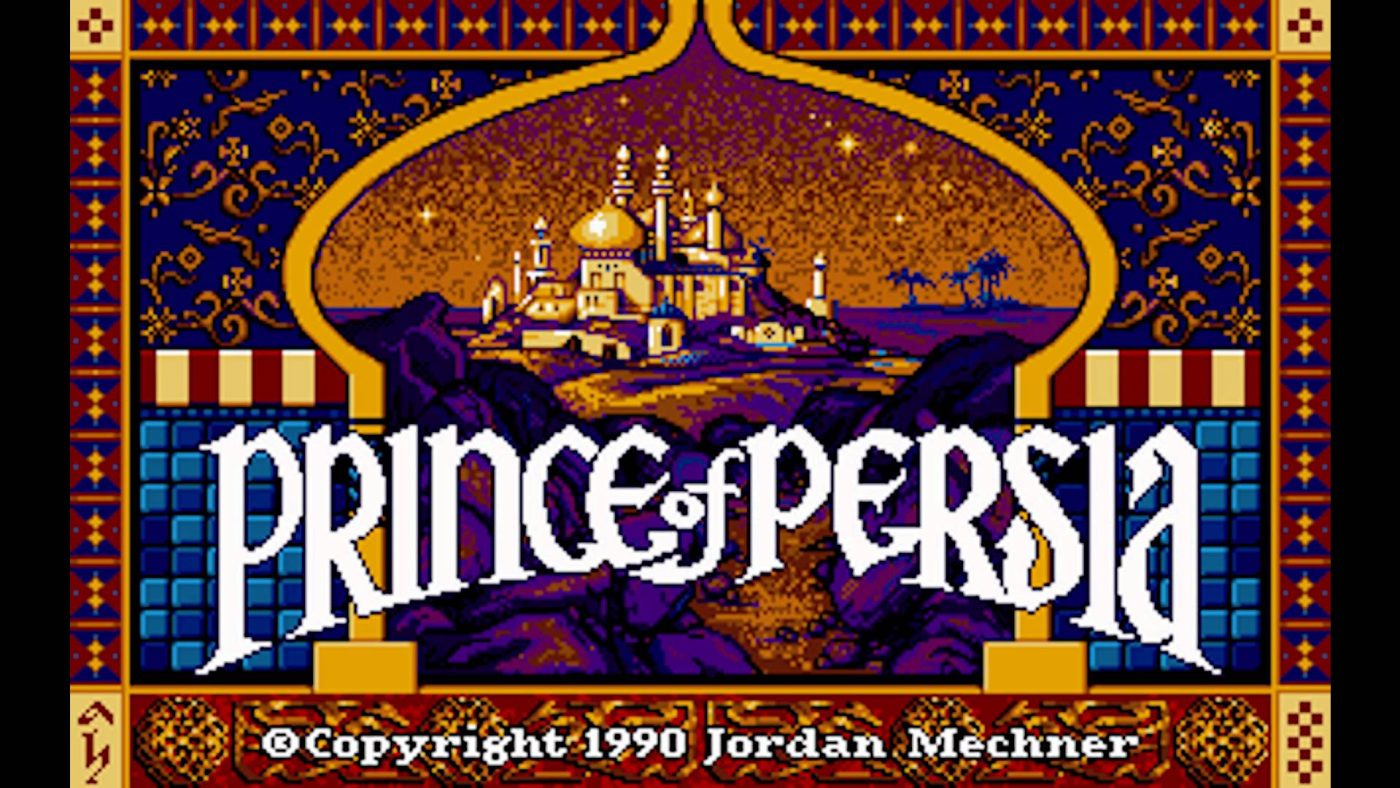
As we saw incomboanalysis of Prehistorik, some of them established a symbiotic relationship, with genres that, such as Platforms, acted as a common thread for others such as adventure, combat, puzzles or exploration. Little by little, but with a firm step, the world of video games was moving towards maturity. However, there was still a very current concept that was still in its infancy, that of immersion in the modern sense of the term, understood as empathy, identification with the character and his relationship with his environment, a direct consequence of greater realism, among other factors. In that sense, titles like Prince of Persia, developed by Jordan Mechner and distributed by Brøderbund in 1989 for different PC models, constituted a paradigm shift of the first order.
Mechner's game surprises in many aspects, but among them, it is the graphic one of the most noteworthy, only surpassed by the playable section. Realism rises to one of its highest levels in the games of the late eighties. This might be surprising if we take into account the unbelievable appearance of the protagonist, who is the opposite of the features of the typical Persian. It is a individual with blonde hair and light skin, dressed entirely in white; It almost looks like a “pyjama”. There is no doubt that this unusual appearance responds to practical criteria, motivated by the demands imposed by a predominantly dark background in which it is imperative to highlight the character.
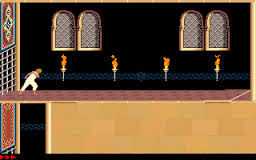

This inaccuracy is more than compensated thanks to the extraordinary treatment of his movements, whose cadence, plasticity and fluidity are unparalleled at the time. The great “culprit” of this technical marvel is the use of rotoscoping, a system of motion capture from real people (Mechner's own brother, dressed in white, volunteered) extrapolated to fictional characters. It had been conceived for animated films, and Prince of Persia It became the pioneer game to use it. This notable feature, combined with the excellent treatment of certain elements such as the columns and floors with a three-dimensional appearance and the ominous appearance of the stages (largely compensating for the monotonous and little variety of its design, reduced to dark dungeons and luxurious, golden palaces), they will imbue the game with an unusual dose of immersion. That, and a gameplay adjusted to an almost human scale which we will discuss below.
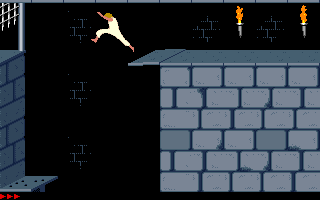

Prince of Persia's control system is simple and intuitive without sacrificing the variety of movements. With the direction keys we will run from one side to the other and carry out vertical jumps, medium distance (in static position) and big jumps (during the race). It will only be necessary to use one more button (Shift, the one we use to momentarily activate the caps) during certain actions, such as grab the edges of platforms, pick up objects (the sword with which we will defend ourselves and potions to recover or extend lives, or lose them if they are poisonous), execute a lunge against the guardians that will await us at certain points of the scenarios (never more than one) or walk stealthily step by step to avoid falling into the void or succumbing to the traps of spikes or the lethal ones guillotines that will split the character in two at the slightest carelessness.
Dichos movimientos se ejecutan con sumo realismo. Gracias a las técnicas descritas más arriba, su comportamiento y movimientos son casi humanos. Por ejemplo, para ejecutar un salto en carrera de forma satisfactoria, nuestro héroe deberá contar con cierto margen de maniobra para dar los pasos necesarios. De lo contrario, se precipitará al vacío y, según a la altura en la que se encuentre, podría conllevar la pérdida de un triángulo de su medidor de vida, o simplemente morir despeñado. Este fenómeno, sumado al hecho de que jugamos a contrarreloj, nos hará ser sumamente cuidadosos con todos y cada uno de sus movimientos, pues un paso en falso puede ser fatal. Esto conlleva que el jugador realmente tema por la vida del personaje, logrando un nivel de inmersión nunca visto hasta ese momento.
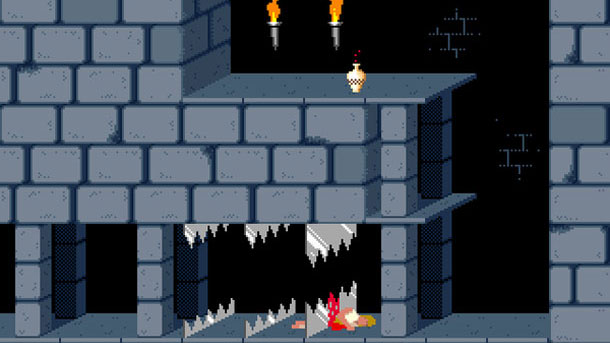

El juego presenta una jugabilidad en 2D, de perspectiva lateral, y con cámara fija (sin scrool), como viene siendo habitual en ese tipo de plataformas mucho más heterogéneas en cuanto a potencia que las videoconsolas, que a diferencia de los primeros, cuentan con un hardware unificado por cada plataforma. Cuando llegamos al borde de una pantalla, automáticamente pasa a la siguiente. Este sistema tiene sus ventajas y sus inconvenientes. Por una parte, contribuye a generar una sensación de incertidumbre al no saber con qué dificultad nos encontraremos en la siguiente pantalla, máxime en escenarios tan amplios, intrincados y prolijos en trampas, desafíos, precipicios y enemigos de toda clase. Pero como contrapartida, en algunos momentos nos restará capacidad de reacción a determinadas necesidades del momento, como a la hora de tomar carrerilla para salvar un precipicio. Quizás sea esa prácticamente la única mancha en su jugabilidad, a pesar de no ser excesivamente importante.
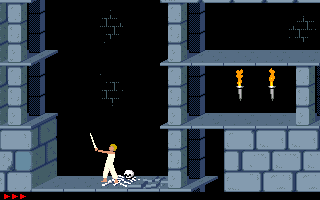

La duración teórica del juego tiene su razón de ser en la historia del mismo. En ausencia del Sultán, el malvado visir y hechicero Jaffar, que ambiciona hacerse con el trono, confinó a la princesa en sus aposentos bajo un ultimátum: si pasada una hora no accedía a contraer matrimonio con él (pasando a ser el nuevo sultán), sería ejecutada. Durante esa hora, el héroe de la aventura deberá surcar las mazmorras y recintos palaciegos hasta derrotar al cruel Jaffar y rescatar a su amada. Por tanto, el eje central del desarrollo del juego es el tiempo en lugar del número de muertes del jugador. Ahora bien, debido a que será necesario regresar al punto de partida de cada nivel cada vez que este fallezca y a la creciente extensión y dificultad de los trece niveles que componen la aventura, nos conviene morir el menor número posible de veces si queremos completar la partida. La exigente curva de dificultad hará que esta meta sea todo un reto.
En contraposición con todo ello, el sound se caracteriza por ser su apartado más discreto, si bien cumple su cometido a la perfección. Las fases carecen de tema musical, y se reducen a breves melodías de unos pocos acordes durante los eventos más trascendentales del juego, como al inicio y final de los niveles, la recuperación o ampliación de vidas o tras la muerte del personaje. Eso sí, los efectos sonoros son de lo más variado y realista (ruptura de baldosas, apertura y cierre de portones, ruido de pasos, tragos al beber una poción, gritos y quejidos del personaje al caer al vacío y resultar herido, etc.). Evidentemente, si el sonido es emitido por el altavoz interno de la CPU (no era raro que ciertos ordenadores antiguos sólo dispusieran de ese sistema de sonido), estos quedarán deformados a melodías y sonidos metálicos o serán directamente anulados.
Prince of Persia supuso un antes y un después en términos de realismo. Sus animaciones casi humanas, los escenarios repetitivos pero bien conseguidos, la multitud de obstáculos y desafíos, y la tensión añadida propiciada por el factor tiempo dieron una vuelta de tuerca al género de plataformas y al concepto de inmersión. La exigencia del título en materia de dificultad puede que disuada a alguien, lo cual no impide que siga siendo un título sobresaliente en prácticamente todos los aspectos. Tampoco conviene olvidar que constituyó el inicio de una saga que a día de hoy sigue contando con con plena vigencia.
Calificación: 10


Martin Fernandez
Prince of Persia es un juego hacia el cual tengo sensaciones mixtas, me parece que esta muy bien hecho, planeado, animado y en general da la sensación de ser un juego sólido conseguido a través de trabajo constante y concienzudo. Sin embargo nunca he llegado a ser un gran fan del juego, principalmente debido a que no soy bueno jugándolo, pierdo la paciencia y me cuesta recordar donde he de ir poco a poco, saltar, correr, etc. Quizás ello se deba a que mi primer contacto con este juego fue cuando era un crío, pero es cierto que años más tarde tuve la versión de Super Nintendo (que añade mejoras gráficas, sonoras y también modifica los niveles) y tampoco llegué a completarlo.
Pese a no ser uno de mis juegos favoritos, creo que es muy bueno y su jugabilidad metódica y pausada inspiró a muchos juegos, incluyendo algunos que se alejaban de la fórmula original de manera notable como Abe’s Oddysee o Black Thorne y que curiosamente me gustan más.
Calificación: 7
Related Articles
![[Analysis] Mixtape: the narrative adventure that turns a 90s mixtape into an unforgettable video game](https://combogamer.com/wp-content/uploads/2026/07/mixtape-poster-300x160.png)
![[Analysis] Scholar Adventure: Mystery of Silence — A Journey to an Abbey that Whispers Secrets](https://combogamer.com/wp-content/uploads/2026/06/Scholar-Adventure-Mystery-of-Silence_poster-300x169.png)
![[Analysis] OUTBLAST — When 2000s Arcade Puts on the VR Goggles (and Still Unimpressed)](https://combogamer.com/wp-content/uploads/2026/06/OUTBLAST-poster-300x172.jpg)
![[Analysis] NODE: The Last Favor of the Antarii — Program Every Leap to Save the World](https://combogamer.com/wp-content/uploads/2026/06/NODE-poster-300x169.jpeg)
![[Analysis] Echo Generation 2 — When a Sequel Risks Everything](https://combogamer.com/wp-content/uploads/2026/06/Echo-Generation-2-poster-300x169.jpg)