


Table of Contents
- A visual feast of the grotesque
- Demi Moore: The queen of body horror
- Margaret Qualley: The other side of the coin
- Dennis Quaid: The villain you love to hate
- Social satire: A warped mirror of our reality
- The visual style: A psychedelic trip through Hollywood hell
- The rhythm: An emotional roller coaster
- The ending: A crescendo of madness
- Conclusion: A trip that you will not easily forget
- Some curiosities about The Substance
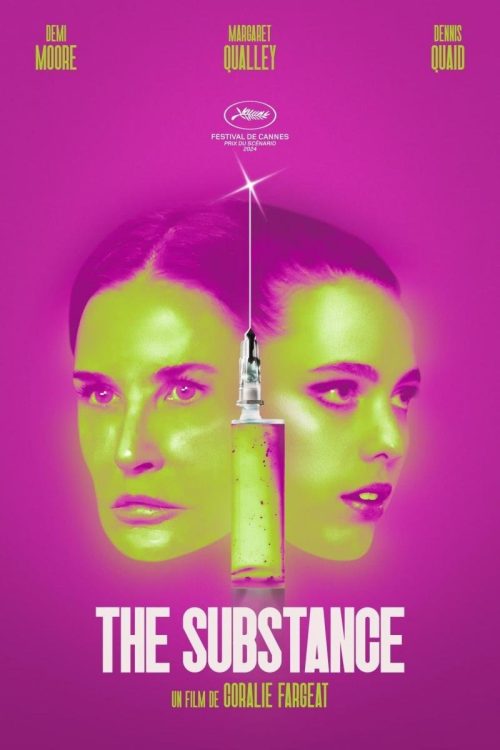
Imagine you are a fading Hollywood star. Your career, which once shone with the intensity of a thousand suns, now flickers dimly like a candle about to go out. What would you do if you were offered the chance to regain your youth and beauty, but at a potentially devastating cost? This is the dilemma faced by Elisabeth Sparkle, played by a braveDemi Moore, in the movie "The Substance."
Elisabeth, once an acclaimed actress and now reduced to hosting a television exercise show, finds herself at a crossroads when her boss, the unpleasant Harvey (Dennis Quaidin total repulsive mode), decides that she is too old to be in front of the cameras.
Just when it seems that all is lost, a mysterious nurse enters the scene, offering Elisabeth a miraculous solution: a black market drug known as "The Substance."
This drug is not your typical fountain of youth in pill form. It's much more complicated and disturbing than that. The Substance literally creates a younger version of Elisabeth, played byMargaret Qualley. But here's the catch: both versions of Elisabeth must alternate weekly to maintain the illusion and, more importantly, to survive.
What follows is a dizzying descent into chaos, body horror, and a scathing critique of our society's obsession with youth and beauty. As Elisabeth and her young doppelgänger navigate the complexities of sharing a life and an identity, things inevitably spiral out of control in ways that are both hilarious and horrifying.
A visual feast of the grotesque
Now, if you have a sensitive stomach, you might want to think twice before watching "The Substance." The directorCoralie FargeatIt doesn't skimp on the grotesque visual effects and gore. There are scenes that will make you want to look away, but at the same time you won't be able to stop watching. It's like David Cronenberg and Quentin Tarantino had a movie baby, and then that baby was raised by John Waters.
One of the most memorable (and disturbing) scenes involves a spinal cord puncture that makes the famous ear piercing scene in "Reservoir Dogs" look like an episode of "Barney and Friends." And let's not talk about what happens when the rules of use of The Substance are broken. Let's just say it involves more bodily fluids than you'd ever want to see on a big screen.
But here's the thing: despite (or perhaps because of) all the gore and visual insanity, "The Substance" is surprisingly fun. There is a dark humor that permeates the entire film, making even the most disturbing scenes have a touch of absurd comedy. It's like you're watching a car crash in slow motion, but the crash is full of clowns and confetti.

Demi Moore: The queen of body horror
Let's talk about Demi Moore for a moment. If you ever thought his career had peaked with "Ghost" either "Striptease«Get ready for a surprise. Moore gives herself completely to this role, leaving aside any vanity or pretense of Hollywood glamour. Her portrayal of Elisabeth is raw, vulnerable, and at times downright terrifying.
There is one scene in particular where Elisabeth looks in the mirror, disgusted with what she sees. Instead of simply frowning or sighing dramatically, Moore rips off her false eyelashes and smears lipstick all over her face in a frenzy of self-deprecation. It's a breathless moment, not only because of its intensity, but because of Moore's willingness to appear so completely undone.
And when it comes time to interact with his younger self, played by Qualley, Moore is no slouch. The chemistry (or rather, antipathy) between the two is palpable. Watching them face off is like watching a particularly violent tennis match, where balls have been replaced by sharp insults and occasionally blunt objects.

Margaret Qualley: The other side of the coin
For her part, Margaret Qualley does an equally impressive job as the younger version of Elisabeth, or "Sue" as she calls herself. Qualley manages to capture the essence of Elisabeth – her ambition, her insecurity, her desperation to be loved – but filters it through the lens of youth and inexperience.
Watching Sue navigate show business with Elisabeth's knowledge and connections, but without her years of experience, is fascinating. There's a moment where Sue is at a party, surrounded by people she supposedly knows, and the confusion and panic in her eyes is almost palpable. It's like watching a child trying to pretend to be an adult, only this child has the power to destroy Elisabeth's life with a single mistake.
The dynamic between Moore and Qualley is the beating (and bleeding) heart of the film. Their interactions range from the comic to the tragic, sometimes in the same scene. There's a moment where they're fighting over who gets to keep the "original" body that's so absurd you can't help but laugh, but at the same time it's deeply sad to see these two versions of the same person so desperate to exist.

Dennis Quaid: The villain you love to hate
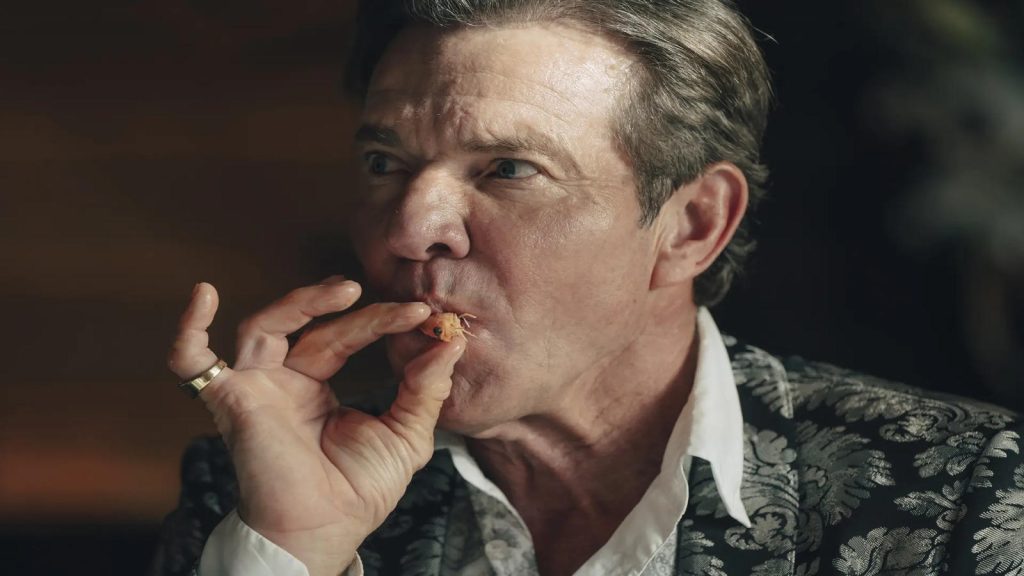
And then there's Dennis Quaid as Harvey, the television executive who is basically the embodiment of everything that's wrong with the entertainment industry. Quaid throws himself into this role, creating a character so unlikeable you can almost smell his cheap cologne through the screen.
Harvey is the kind of guy who eats shrimp and mayonnaise while telling a woman she's too old to be relevant anymore. He's the kind of boss who says goodbye with a smile on his face and then asks if you can get him a coffee before you leave. In short, he's a complete asshole, and Quaid seems to be enjoying every second of it.
There's one scene in particular where Harvey is in the bathroom, talking on the phone about how he's going to fire Elisabeth, not realizing that she's in one of the stalls listening to everything. The way Quaid delivers his lines, with a mix of casual disdain and almost childish enthusiasm for his own cruelty, is both hilarious and deeply disturbing.
Social satire: A warped mirror of our reality
Although "The Substance" is presented as a body horror film, at its core it is a biting satire of our cultural obsession with youth and beauty. The film pulls no punches in its critique of the entertainment industry and the way it treats women, especially as they age.
The very concept of The Substance – a drug that literally allows you to replace yourself with a younger version – is a thinly veiled metaphor for the lengths to which people, especially in Hollywood, are willing to go to maintain a youthful appearance. It's as if Fargeat took all the anti-aging creams, botox treatments, and plastic surgeries, threw them in a blender, and created this monstrous miracle drug. Or even like a steroid version of Ozempic or whatever it is that so many famous people have taken these days, who reappeared thinner and younger than ever, to the point that they look like a different person.
But the film goes beyond simply stating the obvious. It also explores the psychological consequences of living in a society that values youth above all else. We see how this obsession affects not only Elisabeth, but also Sue, who despite having everything Elisabeth wanted – youth, beauty, opportunities – continues to feel dissatisfied and scared.
There is a particularly striking scene where Sue is looking at her reflection in a mirror, touching her face in a mixture of shock and horror. She is young and beautiful, but she knows that she is a fake, a copy created in a laboratory. How do you define yourself when your very existence is a lie? It's a question the film raises but wisely leaves unanswered.
The visual style: A psychedelic trip through Hollywood hell
Visually, “The Substance” displays an outstanding style, although at times it can make you want to vomit. Fargeat has a distinctive style that mixes bright, neon colors with grotesque and disturbing imagery. It's like someone took a movie from the '80s and put it through a nightmarish filter.
Las escenas en el estudio de televisión donde Elisabeth graba su programa de ejercicios son particularmente memorables. Los colores son tan brillantes y saturados que casi duelen a la vista, creando un contraste inquietante con la desesperación y el miedo que vemos en los ojos de Elisabeth. Es como si el mundo exterior fuera una fachada brillante y alegre que oculta la podredumbre y la decadencia que hay debajo.
Y luego están las escenas de transformación, donde vemos el efecto de La Sustancia en el cuerpo de Elisabeth. Estas secuencias que mezclan efectos prácticos y CGI, crean imágenes que son a la vez fascinantes y profundamente perturbadoras. Verás cosas que no puedes des-ver, y probablemente te encuentres revisando tu propio cuerpo en busca de signos de… bueno, mejor no spoilear demasiado.

The rhythm: An emotional roller coaster
Con una duración de más de dos horas, «La Sustancia» podría haber sido una experiencia agotadora. Sin embargo, Fargeat mantiene las cosas en movimiento a un ritmo vertiginoso. La película alterna entre momentos de tensión insoportable y explosiones de violencia y horror que te dejan sin aliento.
Hay momentos en los que la película se toma un respiro, permitiéndote procesar lo que has visto y prepararte para lo que viene. Estos momentos más tranquilos a menudo involucran a Elisabeth o Sue reflexionando sobre su situación, y son igualmente poderosos en su quietud como las escenas más frenéticas lo son en su intensidad.
Sin embargo, incluso en estos momentos más tranquilos, hay una sensación constante de inquietud. Sabes que las cosas inevitablemente van a salir mal, y esta anticipación crea una tensión que nunca desaparece completamente.

The ending: A crescendo of madness
Sin entrar en detalles específicos para evitar spoilers, el final de «La Sustancia» es una muestra de locura cinematográfica. Todas las tensiones y conflictos que se han estado acumulando a lo largo de la película explotan en un clímax que es a partes iguales horripilante, hilarante y extrañamente conmovedor.
Es un final que te deja aturdido, tratando de procesar lo que acabas de ver. No es un final feliz en el sentido tradicional, pero tampoco es completamente desolador. Es complicado y ambiguo, al igual que los temas que la película ha estado explorando.
Lo que es seguro es que el final te dejará pensando. Días después de ver la película, te encontrarás reflexionando sobre sus implicaciones, tratando de desentrañar sus metáforas y simbolismos. Es el tipo de final que invita a múltiples visualizaciones y discusiones acaloradas con amigos.

Conclusion: A trip that you will not easily forget
«La Sustancia» no es una película para todos. Su combinación de horror corporal extremo, sátira social mordaz y humor negro no será del agrado de todos. Algunos la encontrarán demasiado grotesca, otros demasiado sobre la nariz en su mensaje.
Pero para aquellos que estén dispuestos a sumergirse en su locura, «La Sustancia» ofrece una experiencia cinematográfica única. Es una película que te desafía, te perturba y te hace reír, a veces todo al mismo tiempo.
Demi Moore entrega una de las mejores actuaciones de su carrera, mostrando una vulnerabilidad y una disposición a ir a lugares oscuros que es verdaderamente impresionante. Margaret Qualley demuestra una vez más por qué es una de las actrices jóvenes más emocionantes de la actualidad, igualando a Moore en intensidad y compromiso.
Coralie Fargeat se establece firmemente como una directora a tener en cuenta, creando un mundo visualmente deslumbrante y temáticamente rico que se queda contigo mucho después de que terminen los créditos.
«La Sustancia» es una película que te sacude, te revuelve el estómago y te hace cuestionar tus propias nociones de belleza, identidad y el costo de la fama. No es una experiencia cómoda, pero es una que vale la pena tener. Solo asegúrate de no comer nada antes de verla.

Some curiosities about The Substance
- Ray Liottafue elegido para la película en febrero de 2022, pero murió en mayo de ese año antes de poder filmar sus escenas. Dennis Quaid lo reemplazó, pero Liotta todavía se menciona en las «Notas de agradecimiento» de la directora durante los créditos.
- Margaret Qualley reveló en entrevistas que sus pechos en la película no son los suyos; son prótesis diseñadas por el maquillador francés Pierre Olivier Persin. Qualley declaró: «Desafortunadamente, no existe una poción mágica para los senos, así que tuvimos que pegarlos. Coralie Fargeat (la directora de la película) encontró un equipo de prótesis increíble para dotarme con los mejores pechos de mi vida, pero no de mi vida real».
- Demi Moore dijo que estaba nerviosa por filmar desnudez total a los 61 años y se sentía vulnerable. Pero ella le dio crédito a su coprotagonista Margaret Qualley, quien tenía 29 años en el momento de la filmación e interpretó una versión más joven de su personaje, por hacerla sentir cómoda en el set. Qualley también actuó totalmente desnuda. Moore dijo que encontró «alguien que era una gran compañera con la que me sentí muy segura. Obviamente estábamos bastante cerca -desnudas- y también nos divertimos mucho en esos momentos por lo absurdas que eran ciertas situaciones».
- En la película, Elisabeth Sparkle cumple 50 años. Demi Moore, quien interpreta al personaje, tenía 61 años en el momento de filmar la película.
- En varias entrevistas, Demi Moore dijo que leer el guión de esta película le recordó el guión de Ghost, la sombra del amor (1990), porque la posibilidad de que pudiera ser increíble o un desastre era la misma. Eso fue crucial para que ella aceptara el papel.
- Originalmente, Universal Pictures estaba comprometida a distribuir la película a través de su acuerdo con la productora de la película Working Title. En algún momento durante la realización de la película, terminaron alejándose del proyecto. Según The Hollywood Reporter, varias fuentes dijeron que Universal estaba «preocupada por la perspectiva de estrenar la película». Mubi terminó adquiriendo los derechos mundiales de la película poco antes de su estreno en el Festival de Cine de Cannes en competencia.
- Demi Moore no fue la primera opción de Coralie Fargeat. Durante una reunión en París, Moore le dio a Fargeat una copia de sus memorias de 2019, lo que la convenció de elegirla debido a la descripción que hacía de su relación con su cuerpo durante los primeros y mejores años de su carrera cinematográfica.
- El estreno más taquillero de Mubi.
- Demi Moore trabajó junto a la madre de Margaret Qualley,Andie MacDowell, en El primer año del resto de nuestras vidas (1985).
- En algunas escenas, se ve a Sue usando aretes en forma de estrella. Los aretes de estrella son similares a los aretes que usa Jen enVenganza del más allá («Revenge», 2017), la película anterior de la directora Coralie Fargeat.
- Una de las películas favoritas de Margaret Qualley es Juego de gemelas (1998), protagonizada por Dennis Quaid, quien salió brevemente con su madre Andie MacDowell.
- Coralie Fargeat ha citado La mosca (1986) de David Cronenberg como una influencia en esta película. Ambas películas incluyen un momento en el que la protagonista se quita una uña de su dedo podrido.
- La escena en la que Sue mete la mano en el estómago y saca la pata de pollo es una referencia visual a David Cronenberg. Tanto en Videodrome como en Existenz, los personajes se meten la mano en el estómago y sacan armas de una manera muy similar. En Existenz, el arma está hecha de huesos de animales.
Related Articles
![[HorrorScience] Obsession: turning the classic "be careful what you wish for" into a nightmare](https://combogamer.com/wp-content/uploads/2026/07/obsession-poster-300x169.jpg)
![[HorrorScience] Backrooms: the A24 film that turned an internet creepypasta into a horror phenomenon](https://combogamer.com/wp-content/uploads/2026/07/backrooms-poster-300x169.jpg)
![[HorrorScience] Victor Crowley (Hatchet IV): The fourth installment that arrived without warning](https://combogamer.com/wp-content/uploads/2026/06/victor_crowley-poster-300x169.jpg)
![[HorrorScience] Number 23 (2007)](https://combogamer.com/wp-content/uploads/2026/05/El-numero-23-banner-largo-300x169.jpg)
![[HorrorScience] Hokum: When a bitter writer meets an Irish witch](https://combogamer.com/wp-content/uploads/2026/06/hokum-poster-300x169.jpg)
![[HorrorScience] The man who could cheat death](https://combogamer.com/wp-content/uploads/2026/04/The-man-cheated-death-banner-300x165.png)