
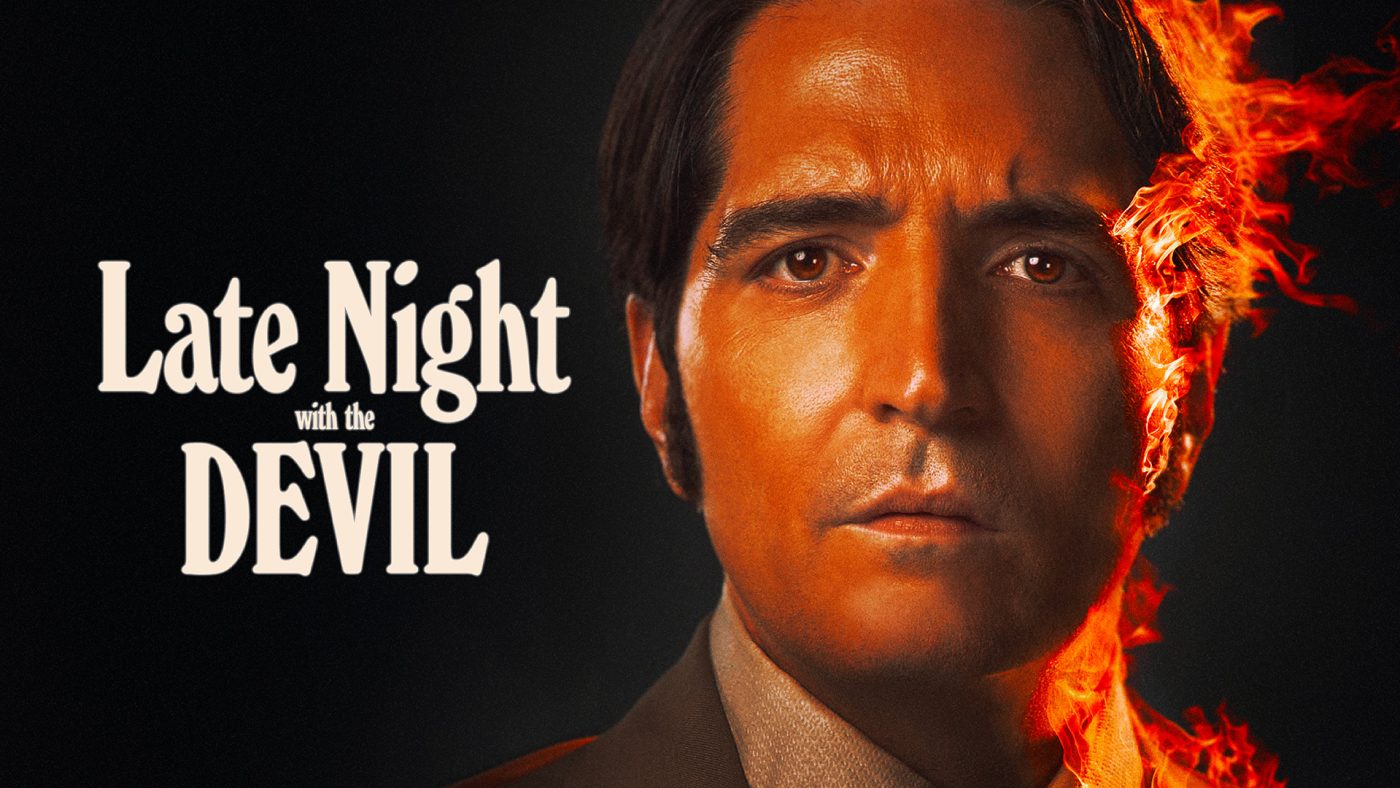

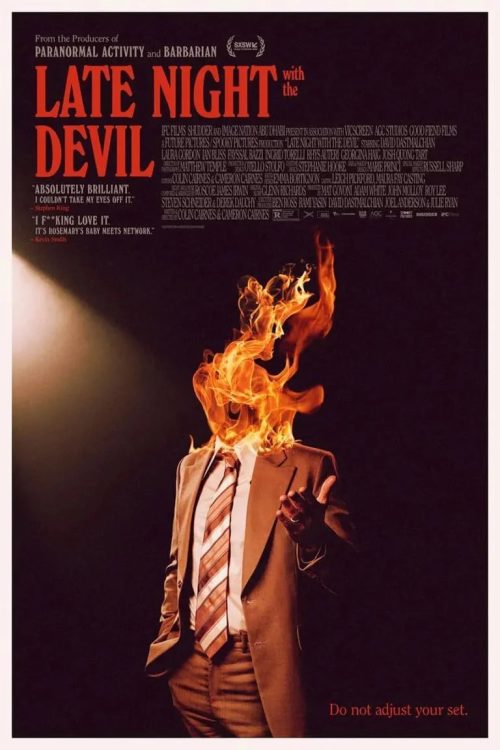
Imagine tuning into your favorite talk show on Halloween night in 1977, only to be met with a show that quickly turns into a live nightmare.«Late Night with the Devil», directed by brothers Cameron and Colin Cairnes, takes us to that precise moment, capturing the essence of a golden age of late-night television while delivering an unforgettable horror experience. With an intriguing premise and an atmosphere that perfectly evokes the 70s, this film has managed to captivate both critics and viewers.
The plot of "Late Night with the Devil" introduces us to Jack Delroy, masterfully played by David Dastmalchian, the charismatic host of the late-night talk show "Night Owls with Jack Delroy." Desperate to boost his show's ratings, Jack decides to host a Halloween special that promises to be unforgettable. However, things don't go as planned when he invites a supposedly possessed girl onto the show, unleashing chaos and horror on live television. What begins as a desperate ploy to capture the public's attention quickly turns into a fight for survival against supernatural forces.
From the first moment, the film envelops us in an atmosphere that mixes nostalgia and terror. The Cairnes brothers have managed to accurately recreate the aesthetics of the 70s television shows, from the lighting to the sets and costumes. This attention to detail not only adds authenticity to the film, but also transports us back to a time where late night television had an air of mystery and danger.
One of the highlights of "Late Night with the Devil" is its ability to keep the viewer on the edge of their seat. The tension builds gradually, and each scene is charged with a sense of anticipation that is almost palpable. The performances are exceptional, with Dastmalchian delivering a compelling and nuanced performance as a man desperate for success, but who ends up facing forces beyond his control.
The film also benefits from a smart, well-written script. The dialogues are natural and believable, and the plot is full of twists and surprises that keep the viewer's interest. Additionally, the inclusion of supernatural and religious horror elements adds an additional layer of complexity and depth to the story.
The cinematography of "Late Night with the Devil" perfectly captures the atmosphere of the '70s, with saturated colors and lighting that add a touch of surrealism to the film. The special effects, which combine practical techniques with CGI, are impressive and contribute to the feeling of horror and bewilderment that permeates the film.
Reviews have been overwhelmingly positive.Stephen King, the master of horror, described the film as "absolutely brilliant" and highlighted its ability to keep the viewer glued to the screen. On Rotten Tomatoes, "Late Night with the Devil" has achieved a 100% rating, an impressive achievement that speaks to the quality and impact of the film.
But beyond the criticisms, what really makes "Late Night with the Devil" special is its ability to capture the essence of an era and a genre. The film not only pays homage to '70s television shows, but also uses that aesthetic to tell a story that is both terrifying and deeply human. Jack Delroy's desperation to save his show and his career is something many can relate to, and his fight against the dark forces he unleashes is a reminder of the dangers of playing with the unknown.
The Cairnes brothers' direction is impeccable, and their attention to detail is evident in every frame. From the sets to the costumes, everything in the film is designed to transport us back to 1977. But beyond the aesthetics, it's its ability to tell a compelling story that really stands out. Every twist and reveal is carefully planned to keep us on the edge of our seats, and the film's climax is as shocking as it is satisfying.
The performances of the supporting actors also deserve a special mention. The possessed girl, played by a young actress whose name we will surely remember in the future, gives a chilling performance that adds an extra layer of terror to the film. The show's guests, each with their own stories and secrets, contribute to the feeling that we are watching something real and dangerous.
The film also makes excellent use of the talk show format. Commercial interruptions, audience interactions and behind-the-scenes moments add authenticity to the experience andThey make us feel like we are watching a real 70's TV show. This metatextual approach not only adds depth to the story, but also allows us to see how the characters react to the growing tension and chaos.
In conclusion, "Late Night with the Devil" pays homage to '70s television shows while offering a unique and terrifying cinematic experience. With exceptional performances, impeccable setting and an edge-of-your-seat plot, this film is a perfect tribute to a golden era of television horror. For lovers of horror and nostalgia, "Late Night with the Devil" is a film not to be missed. A devilishly fun and chilling experience that will leave you wanting more!
Some (many!) curiosities about "Late Night with the Devil"
- Carmichael's character is clearly based (even physically) on theJames Randifrom real life. Randi was a talented magician who became a famous debunker of psychic powers and founded an institute that offered a large reward to anyone who could reproduce his supposed paranormal powers under controlled conditions. For decades, no one could earn the money.
- Traditional folklore states that if a person makes a contract with the Devil for earthly goods, the Devil will come to claim payment in seven years. The "documentary footage" at the beginning of the film shows Delroy in the Grove in 1969. His wife dies in 1976, seven years later.
- In a 2024 interview with The Moveable Fest, Colin Cairnes explained the reason the film is set in 1977: "The film had to happen on a Monday night during Sweepstakes Week, so the stakes are high and this is the start of the week that's going to make or break Jack Delroy's career, right? And it turned out that 1977 was the only year in the '70s that Halloween fell on a Monday night, so we thought, '77, it's kind of in the middle.' And that worked for us."
- The name of the mysterious men's-only club in the redwood forests of California was "The Grove." He was inspired byBohemian Grovereal life located at 20601 Bohemian Avenue in Monte Rio, California. Bohemian Grove's membership includes several politicians (including three United States presidents), industrialists, and other prominent figures. One of the actual founders of the Grove was Ambrose Bierce, author of several horror stories and the cynical Devil's Dictionary. The Grove's rituals, which have been described as somewhere between the occult and kitsch, include frequent images of owls.
- Actor David Dastmalchian was cast in the film's lead role and central character, Jack Delroy, after the film's directors read an article he had written for Fangoria magazine about regional horror show hosts. Co-director Colin Cairnes said in an interview with the director of the film that Two directors published in this magazine: »Well, I mean other things besides recognizing his incredible work and all the films he has participated in. But one day I opened 'Fango' and read an article by David about regional horror movie presenters. And upon reading it, and knowing his work, I thought: 'He's going to be a really good option.' Obviously, our hero Jack is a TV presenter, so I felt there would be some affinity there.
- Cult leader Szandor D'Abo appears to be based on the founder of the Church of Satan,Anton Szandor LaVey.
- The opening black-and-white sequence lasts about eight minutes. It was inspired by the 80's shock documentaryMurdering North America(1981). The subsequent black and white sequences of the film are the on-set and off-air interludes during commercial breaks.
- In a 2023 interview with The Hollywood Reporter, Cameron Cairnes gave details about the film's production schedule, shooting process, and design: "We had 20 days in a studio, essentially on location on what was basically a 360-degree set. We shot the movie as if it were a television show with three cameras running the entire time. There was a temptation to shoot with old tube cameras, but just with the effects and demands and everything else, we ended up shooting digitally. For the set design, the inspiration was a lot of those game shows and talk shows from that period, and we were lucky to have a production designer who worked at the time on local television here, including a very popular music show called Countdown (1974). I think it was very easy for him to come up with that design. And that palette of browns, oranges and beige. “It all seemed very of the period, and we really embraced it.”
- The filmmakers of this horror film, "The Cairnes Brothers", Colin Cairnes and Cameron Cairnes, have said about this film in an official statement: "In the 70s and 80s there was something slightly dangerous about late night television. Talk shows in particular were a window into a strange adult world. “We thought combining that charged atmosphere of live streaming with the supernatural could make for an exceptionally terrifying cinematic experience.”
- Famed horror novelist Stephen King has praised the film. He said: "It's absolutely brilliant. I couldn't take my eyes off him. Results may vary, as they say, but I urge you to watch it when you can.
- Christou's stage name resembles two real-life psychics/mentalists. Criswell (Charles Criswell King) was most famous for his outlandish (and mostly inaccurate) predictions, while The Amazing Kreskin (George Joseph Kresge) has been performing mentalist numbers for over 50 years. Both made several appearances on The Tonight Show With Johnny Carson. Additionally, Christou's appearance bears a passing resemblance to Reveen, an Australian hypnotist who was popular in the 1970s.
- In addition to James Randi, Carmichael Haig looks like Orson Welles (or rather what Welles looked like back when he was a gadfly on late-night talk shows). In addition to being an actor and director, Welles was a skilled stage magician. In a 1970 interview with David Frost, Welles told a story about his brief time as a psychic, explaining in detail how cold reading works. However, Welles reported that he abandoned the psychic act when he gave a reading to a woman and found that her "reading" was disturbingly accurate. Welles dismissed his own psychic abilities, but theorized that professional psychics can fool themselves into believing in their own powers.
- The specific episodes of The Don Lane Show (1975) that inspired this horror film were those featuring Uri Geller and Doris Stokes.
- Footage of a SWAT team in action (~37:00) is actual footage of the Los Angeles Police Department's attempt to serve arrest warrants at 1466 East 54th Street to personnel from the «Symbionese Liberation Army» (SLA), on Sunday, May 19, 1974, which ended in a Branch-Davidian style self-immolation; the SLA was the group that kidnapped and "brainwashed" Hearst heiress Patty Hearst into joining them during several armed bank robberies (she was eventually convicted, served time, and was later pardoned after her release by US President Jimmy Carter).
- The film grossed $666,666 on Sunday, March 24, 2024 at the box office, according to the distributor. Most likely this was not a coincidence, as box office figures can be manipulated by about 5% by the distributor to compensate for revenue that Rentrak does not record.
- When Dr. June Ross-Mitchell attempts to exorcise the demon Abraxas from Lilly, she orders "vade retro Satana." It is a Latin quote used in exorcisms that means "get away from me, Satan" as an exhortation for him to leave.
- The film's late-night talk show was inspired by The Don Lane Show (1975). Australian newspaper ‘The Sydney Morning Herald’ reported on June 2, 2023 that the film “…is inspired by American Don Lane and his eponymous late-night Australian talk show The Don Lane Show (1975).”
- Ian Bliss, who played Carmichael Haig, was originally hired to play another character after he was originally hired to be a cast reader. Bliss had only four days to prepare for the role of Haig, as the original actor dropped out at the last minute.
- El demonio Mr. Wriggles es «un guiño elegante al Capitán Howdy de El exorcista (1973)», según Nikki Baughan en el sitio web ‘Screen Daily’.
- Originalmente, el ejecutivo creativo Preston Fassel dio luz verde como producción para «Fangoria Presents» en 2020 como una posible película para la compañía después de la cuarentena por COVID-19. Poco después de la aprobación de Fassel, la compañía se vendió debido a una controversia que involucraba a los ejecutivos de producción, como se detalla en un artículo de Daily Beast. En los años posteriores a la venta de Fangoria, Fassel continuó defendiendo el guion, incluso nombrándolo en un artículo sobre los mejores guiones no producidos que había leído. Irónicamente, fue un artículo de David Dastmalchian publicado en la resucitada Fangoria lo que llevó a la producción de la película.
- Tercer largometraje cinematográfico escrito y dirigido por los cineastas australianos de películas de terror «The Cairnes Brothers» – Colin Cairnes y Cameron Cairnes. Sus dos primeras películas fueron Scare Campaign (2016) y 100 Bloody Acres (2012).
- Los cortes y los mensajes de la red «volveremos enseguida» se realizaron con IA.
- La tarjeta de «Dificultades técnicas» que aparece se parece mucho a una identificación de estación que KCOP-TV, con sede en Los Ángeles, utilizó a fines de la década de 1970.
- El logotipo de la cadena «UBC» se parece mucho al de ABC (The American Broadcasting Company). La cadena de televisión nacional de Australia también se conoce como ABC, pero tiene un logotipo muy diferente.
- La película rinde un gran homenaje al clásico de Sidney Lumet Network, un mundo implacable (1976), que ganó cuatro Oscar en 1977, año en el que se desarrolla esta historia. Algunos de los elementos tomados prestados: la crítica a la televisión de sangre y tripas y la competencia por los índices de audiencia; el estilo narrativo utilizado en su introducción que muestra la temprana caída del héroe y su declive en popularidad (ambos son presentadores de televisión); y los nombres ficticios de las cadenas que tienen títulos similares (UBC aquí, UBS en Network, un mundo implacable (1976)); y también el estilo visual de algunas tomas.
- En el minuto 46:30 Lilly menciona a Abracadabra, que también es un personaje interpretado por David Dastmalchian en la serie de televisión «The Flash», escrito «Abra Kadabra».
- La agencia de Carmichael Haig se llama IFSIP, abreviatura de Federación Internacional de Investigación Científica sobre lo Paranormal.
- El nombre del programa nocturno estadounidense que se presentaba en la ciudad de Nueva York era »Night Owls», también conocido como »Night Owls with Jack Delroy’.
Related Articles
![[HorrorScience] Obsession: turning the classic "be careful what you wish for" into a nightmare](https://combogamer.com/wp-content/uploads/2026/07/obsession-poster-300x169.jpg)
![[HorrorScience] Backrooms: the A24 film that turned an internet creepypasta into a horror phenomenon](https://combogamer.com/wp-content/uploads/2026/07/backrooms-poster-300x169.jpg)
![[HorrorScience] Victor Crowley (Hatchet IV): The fourth installment that arrived without warning](https://combogamer.com/wp-content/uploads/2026/06/victor_crowley-poster-300x169.jpg)
![[HorrorScience] Number 23 (2007)](https://combogamer.com/wp-content/uploads/2026/05/El-numero-23-banner-largo-300x169.jpg)
![[HorrorScience] Hokum: When a bitter writer meets an Irish witch](https://combogamer.com/wp-content/uploads/2026/06/hokum-poster-300x169.jpg)
![[HorrorScience] The man who could cheat death](https://combogamer.com/wp-content/uploads/2026/04/The-man-cheated-death-banner-300x165.png)