



Table of Contents
- The Underground Passage That Never Ends
- The narrative of Exit 8 focuses on this repetitive exploration that becomes an obsession.
- The Anguish of Repetition and the Urban Metaphor
- How Do You Adapt the Game to a Movie Narrative?
- From Video Game to Cinema: Anomalies and Mixed Reception
- Curiosities about Exit 8
exit 8(2025) is a Japanese horror thriller directed by Genki Kawamura that adapts the viral video game of the same name, turning a simple subway ride into a nightmare of time loops and subtle anomalies that break everyday logic.
The film follows an ordinary man who enters a seemingly normal underground passage, but soon discovers that the environment repeats itself in a disturbing way, with minute variations that generate progressive paranoia and force him to question his perception of reality.
Set in a claustrophobic and almost deserted underground Tokyo, it explores themes of perception, isolation and liminal spaces, offering aslow burnvery Japanese that prioritizes atmosphere and disturbing details overjumpscareseithergoreexplicit, with a minimalist approach that turns the mundane into a source of pure terror.
The Underground Passage That Never Ends
The story begins with a lone man stepping off a nighttime subway into a nearly empty hallway, a space that any urban Japanese person instantly recognizes: bright white tiles, illuminated billboards, the distant echo of trains, and the constant hum of fluorescent lights that never go out. Your only goal is to reach exit 8 and rise to the surface to return home after a tiring day. But from the first steps something doesn't fit. The hallway seems to extend further than normal. A poster that was once perfectly aligned is now slightly askew. A human figure appears in the reflection of a window, but disappears when turned. The protagonist continues walking, convinced that it is just tiredness or imagination.
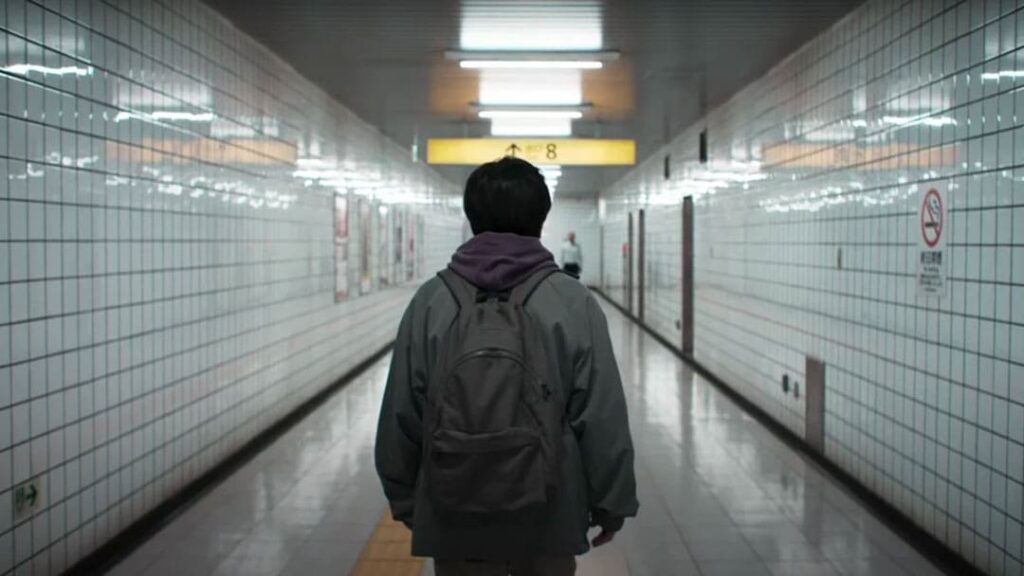
The narrative ofexit 8It focuses on this repetitive exploration that becomes an obsession.
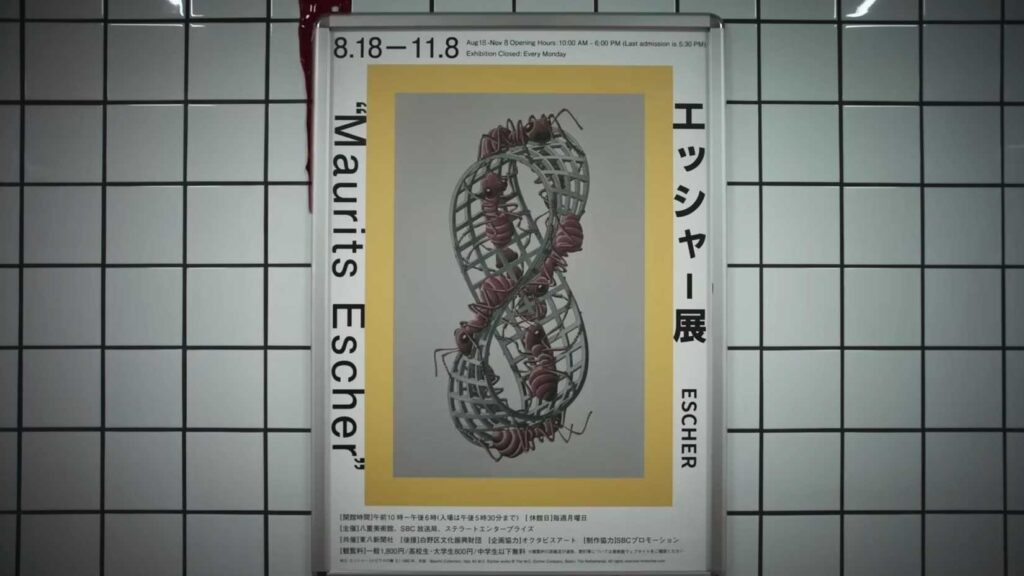
Each time you advance, the environment resets (or not) with minimal but increasingly disturbing variations. A stain on the floor that wasn't there before. A sound that does not belong to the usual meter. The man begins to mentally note these irregularities, trying to discern what is "normal" and what is the key to breaking the cycle. The film dedicates a significant part of its footage to this obsessive routine, where this subway corridor feels alive and hostile, with corners that always lead to the same place, posters that repeat identical advertisements, and characters that repeat themselves.
The isolation is absolute. There appear to be no other passengers. The protagonist tries to scream, hit doors or look for alternative exits, but the design of the passage always returns him to the starting point. The phone does not connect. And the atmosphere becomes oppressive as the minutes that feel like hours pass. The camera follows his steps in long, static shots, amplifying the monotony that hides the horror.
The Anguish of Repetition and the Urban Metaphor
This opening section, which takes up much of the footage, builds palpable anguish through repetition and the mundane. The protagonist reflects on his life as he walks: a routine job that exhausts him, a failed relationship that he did not know how to sustain, the loneliness of the city that surrounds him every night. The subway becomes a metaphor for his stagnant existence. Each loop forces you to pay attention to details you previously ignored, transforming an everyday environment into an inescapable trap that seems designed to break your mind. The film plays with the idea that true terror is not in the supernatural, but in the infinite repetition of the same thing, in the impossibility of moving forward.
How Do You Adapt the Game to a Movie Narrative?
The structure of the film incorporates elements of the original game, such as the need to detect anomalies to "progress", but expands them with sequences that explore the psychology of the protagonist, including fleeting memories of his life outside the subway that are interspersed with the loops, adding emotional depth to the experience. Kawamura uses ambient sound to enhance unease: the echo of lonely footsteps, the occasional whistle of a ghost train or the total silence that makes any noise stand out as a threat. These auditory layers, combined with the cold, uniform lighting of the passage, create an atmosphere that evokes theliminal spacespopular on the internet, those empty hallways that generate unease due to their artificial perfection and lack of life.
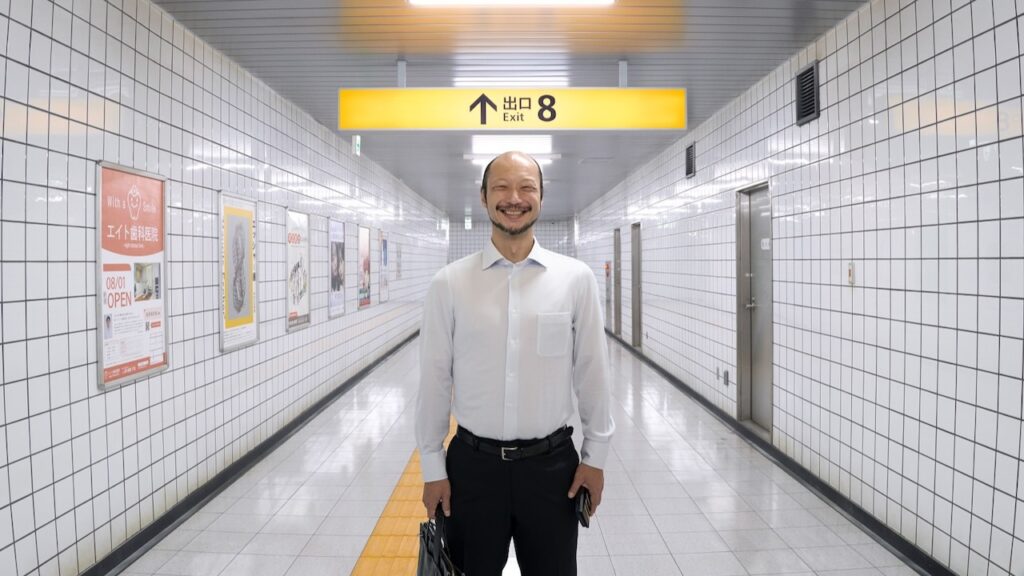
As the loops accumulate, the man experiences physical and mental fatigue. The film avoids extensive dialogue, opting for a visual and sensory approach that makes the horror more immersive, although this may feel monotonous for some viewers. The ending, ambiguous and open, invites multiple interpretations, from a commentary on urban routine to an allegory of depression or personal stagnation, reinforcing the impact of repetition as a narrative tool.
From Video Game to Cinema: Anomalies and Mixed Reception
exit 8faithfully adaptsthe Kotake Create game, awalking simulatoranalog horror where the player detects "anomalies" in an infinite hallway to "advance." The film expands this mechanic to cinema with minimal but effective performances, where the protagonist – played by Kazunari Ninomiya – conveys exhaustion and despair with subtlety, without great dialogues or monologues. The sound design is key: the slap of shoes on the floor, the hum of lights and prolonged silences that make each anomaly stand out more strongly.
In Japan, the film has been a massive success, grossing millions at the box office and receiving praise for its fidelity to the game and its ability to generate concern without resorting to expensive special effects. Outside the country, reviews are more mixed. Something that is to be expected in such a Japanese product. Many criticize that the slow pacing and lack of character development make it repetitive for those who don't know the original, while others see it as a unique sensory experience that perfectly captures the liminal horror of empty spaces.
Visually, the underground passage evokes those liminal spaces that went viral on the internet: empty hallways, cold lighting and distorted perspectives that generate concern due to their artificial perfection. Kawamura uses fluorescent lighting and static shots to enhance the effect, making every subtle anomaly hit hard. Its main weakness is its brevity: it leaves you wanting more explanation about the nature of the loop, but that same lack of answers enhances its impact as a sensory experience rather than a narrative one. The ending, ambiguous and open, leaves the viewer with several questions.
Curiosities aboutexit 8
- The original game is on Steam and Android, and already has millions of downloads.
- The film grossed more than $15 million in Japan in just 11 days, becoming one of the surprise hits of 2025.
- It was shot on a real abandoned subway set in Tokyo to capture authenticity in sounds and textures.
- Genki Kawamura co-wroteYour Name, but here he opts for total minimalism without extensive dialogue or dramatic music.
- Previewed at Sitges 2025, it divided opinions: 96% on Rotten Tomatoes (which is no longer a benchmark for anything), but criticism for being "too faithful to the game" and poorly developed for non-players.
If you have seenexit 8What did you think? Share in the comments!
Related Articles
![[HorrorScience] Obsession: turning the classic "be careful what you wish for" into a nightmare](https://combogamer.com/wp-content/uploads/2026/07/obsession-poster-300x169.jpg)
![[HorrorScience] Backrooms: the A24 film that turned an internet creepypasta into a horror phenomenon](https://combogamer.com/wp-content/uploads/2026/07/backrooms-poster-300x169.jpg)
![[HorrorScience] Victor Crowley (Hatchet IV): The fourth installment that arrived without warning](https://combogamer.com/wp-content/uploads/2026/06/victor_crowley-poster-300x169.jpg)
![[HorrorScience] Number 23 (2007)](https://combogamer.com/wp-content/uploads/2026/05/El-numero-23-banner-largo-300x169.jpg)
![[HorrorScience] Hokum: When a bitter writer meets an Irish witch](https://combogamer.com/wp-content/uploads/2026/06/hokum-poster-300x169.jpg)
![[HorrorScience] The man who could cheat death](https://combogamer.com/wp-content/uploads/2026/04/The-man-cheated-death-banner-300x165.png)