


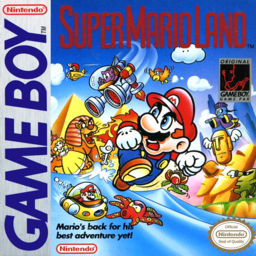
Super Mario Land saw the light of day in the world market in the transition between the end of the eighties and the beginning of the nineties, marking the debut of the plumber in GameBoy. Currently it can also be found in the 3DS Virtual Store. From the outset, this title was preceded by a markedly atypical characteristic, participation in the Gunpei Yokoi project, with which Shigeru Miyamoto, father of the child, would share his work. In the end, their work will bring refreshing air to this title in particular (which will also have an indisputable bestseller) and to the portable sub-saga in general, as we will see below in this and others that are to come.
History itself already shows a glimpse of change within a still traditional basic structure. This takes place in the country of Sasaraland, whose peace is abruptly interrupted when Tatanga, an invader from outer space, invades and kidnaps daisy, the princess of the kingdom. Mario must cross the entire country through his four kingdoms (Birabuto, Muda, Easton and Chai) and defeating their respective rulers, who are under the influence of Tatanga. His final objective will be none other than to make his way to it and rescue Daisy.
This simple argument is enough to introduce us fully to a very peculiar title, full of similarities with respect to Super Mario Bros. (in a way it is a kind of spiritual successor to it), but with a series of new features that make it a quite interesting title.
![[ComboAnalysis] Super Mario Land](https://combogamer.com/wp-content/uploads/2014/02/SML-4.jpg)
Super Mario Land It uses a graphics engine similar to that of the first installment of its adventure on the NES, being almost a black and white adaptation of it. The blocks, enemies, pipes, and scenarios are clearly inspired by this title, although even more simplified. Its simplicity, however, is consistent with the first games that saw the light in this console. For this reason, they are far below what other numerous installments of the Land series of Nintendo characters would later offer. It can represent a problem for the gaming experience if you are playing on an original GB, since these graphics are especially tiring for the eyes, and have not treated the transformations from Super Mario to Mario Flor individually, creating some confusion in the player (a problem that will be corrected in the sequel). The extra life items have been properly adapted, as they become hearts in order to distinguish them from the super-mushrooms.
He simple, catchy and casual character of the melodies also reminds of those of Super Mario Bros., although it has a slightly broader repertoire. To what can be described as the "main melody" (Birabuto and Easton), the subterranean levels and the underwater and aerial phases are added, as well as the themes of Muda and Chai. Its sound effects are nothing out of this world, although they also fall within what they used to be in the first titles on the console..
At a playable level, continuity with the NES title also prevails, with a left-right lateral development, with no possibility of going back or going up or down or seeing beyond what is immediately seen on the screen. Time will still be clocked, and influences the score at the end of each phase. We could even lose a life if it reaches zero. The classic item collection system in the form of coins (they grant one life for every hundred collected) and power-ups (Mushrooms, Flowers, Stars and extra lives), as well as its platform mechanics, ensure that the gaming experience retains its fluid, careful and measured gameplay, the backbone of plumber titles. Furthermore, a new twist has been given to the classic Fire Flower. Now you can only throw a ball that bounces off the floor and walls, being able to collect coins from inaccessible places thanks to it. With a little practice it becomes manageable and does not involve excessive difficulty.
Pero la principal novedad del juego son las fases pilotadas. Constituyen un elemento hasta entonces inédito en las sagas Mario, y añaden un reto extra al juego sin volverlo tedioso. Las fases que siguen esta mecánica son dos: una submarina y otra aérea. Con independencia de cuál se trate, el objetivo es el mismo: disparar a todo el que se encuentre en tu camino y evitar ser alcanzado por los enemigos y trampas que saldrán a nuestro encuentro.
![[ComboAnalysis] Super Mario Land](https://combogamer.com/wp-content/uploads/2014/02/SML-2.png)


El juego incluye cuatro mundos de tres niveles cada uno, frente a los ocho mundos y cuatro niveles de Super Mario Bros.. Por tanto, la duración de la aventura se ve reducida a la mitad de mundos y a casi la tercera parte del total de niveles. Como contrapartida, la variedad de jefes finales aumenta mucho (en el de NES sólo estaba Bowser), y el último nivel cuenta con dos, el de mundo y el del juego (otro elemento inusual). Su escasa duración se compensa con el hecho de que si pierdes sin tener un cierto número de puntos, será necesario empezar de cero. Pero eso no basta para quitarnos la sensación de que se queda corta. El factor rejugabilidad está ahí, pues podremos jugar de nuevo con un mayor grado de dificultad una vez terminada la aventura, así como superar records de puntuación, pero aun así no da para mucho. Eso sí, se adapta perfectamente a lo que requiere un formato portátil, es decir, no muy largo y tampoco muy enrevesado.
Hay mas análisis como este en la Revista Bonus Stage Magazine. Hazte fan en Facebook.


skullomartin
Las principales virtudes de Super Mario Land siguen siendo su jugabilidad, sus innovaciones a la saga de Mario (¡queremos que vuelvan las fases en avión y submarino!) y sus pegadizas músicas. Su apartado gráfico era bueno en su dia, pero no ha soportado bien el paso del tiempo (parece una pintura rupestre al lado de Super Mario Land 2) y su duración no es excesivamente alta, aunque ofrece la posibilidad de rejugarlo en un nivel de dificultad mayor. En general, me quedo con lo bueno, ya que es un título que me provoca diversión inmediata.
Calificación: 7,5

Arkáitz González
Fantástico juego que engancha desde el principio. Con sus pegadizas melodías, sus retos, sus novedades (yo también fui un enamorado de la fase submarina y la fase aérea)… tal vez el apartado gráfico no estuvo tan aprovechado como en otros juegos, pero la diversión que aportaba jugando hacía que uno se olvidase de eso enseguida. Tal vez algo que se echaba en falta era la imposibilidad de guardar la partida, por lo que o te lo pasabas todo de golpe o te tocaba volver a empezar desde el principio del juego. Ni siquiera una vez desbloqueado el nivel más difícil del juego se mantenía tras apagar la consola.
Calificación: 7,5

Ruben Araña Sánchez
Un juego que a pesar de los años sigo jugando mínimo dos veces al año. Si bien su apartado gráfico no es el mejor del mundo y la ambientación dada por el señor Yokoi es de lo más magufo y bizarro que se ha visto en la saga, la pegadiza música y su ritmo sin bajones hace que lo disfrutes de principio a fin. Cierto que su duración deja mucho que desear y que la ausencia de un sistema de guardado puede frustrarte en alguna ocasión, pero como muchos juegos en su época acaba siendo dominación: una y otra vez hasta terminarlo. Sin ser muy fan de los Marios, este a mi gusto es un must have.
Calificación: 8,0

Related Articles
![[Analysis] NODE: The Last Favor of the Antarii — Program Every Leap to Save the World](https://combogamer.com/wp-content/uploads/2026/06/NODE-poster-300x169.jpeg)
![[Analysis] Clockwork Ambrosia understands something that many modern metroidvanias seem to have forgotten: shooting can also be fun](https://combogamer.com/wp-content/uploads/2026/05/clockwork_ambrosia-poster-300x169.jpg)
![[Analysis] REPLACED: a cyberpunk journey that catches the eye, but does it stay in the memory?](https://combogamer.com/wp-content/uploads/2026/04/Replaced_Keyart_Landscape_16x9-300x169.jpg)
![[Analysis] Legacy of Kain: Ascendance: The return of Nosgoth in 2D format that divides fans](https://combogamer.com/wp-content/uploads/2026/04/legacy-of-kain-ascendance-poster-300x169.jpg)
![[Analysis] Origament: A paper letter that travels the world in search of its recipient](https://combogamer.com/wp-content/uploads/2026/04/Origament_poster-300x169.jpg)
![[Analysis] Haunted Lands: A retro platformer with gore and relentless difficulty](https://combogamer.com/wp-content/uploads/2026/04/haunted_lands-poster-300x169.jpg)