

Table of Contents
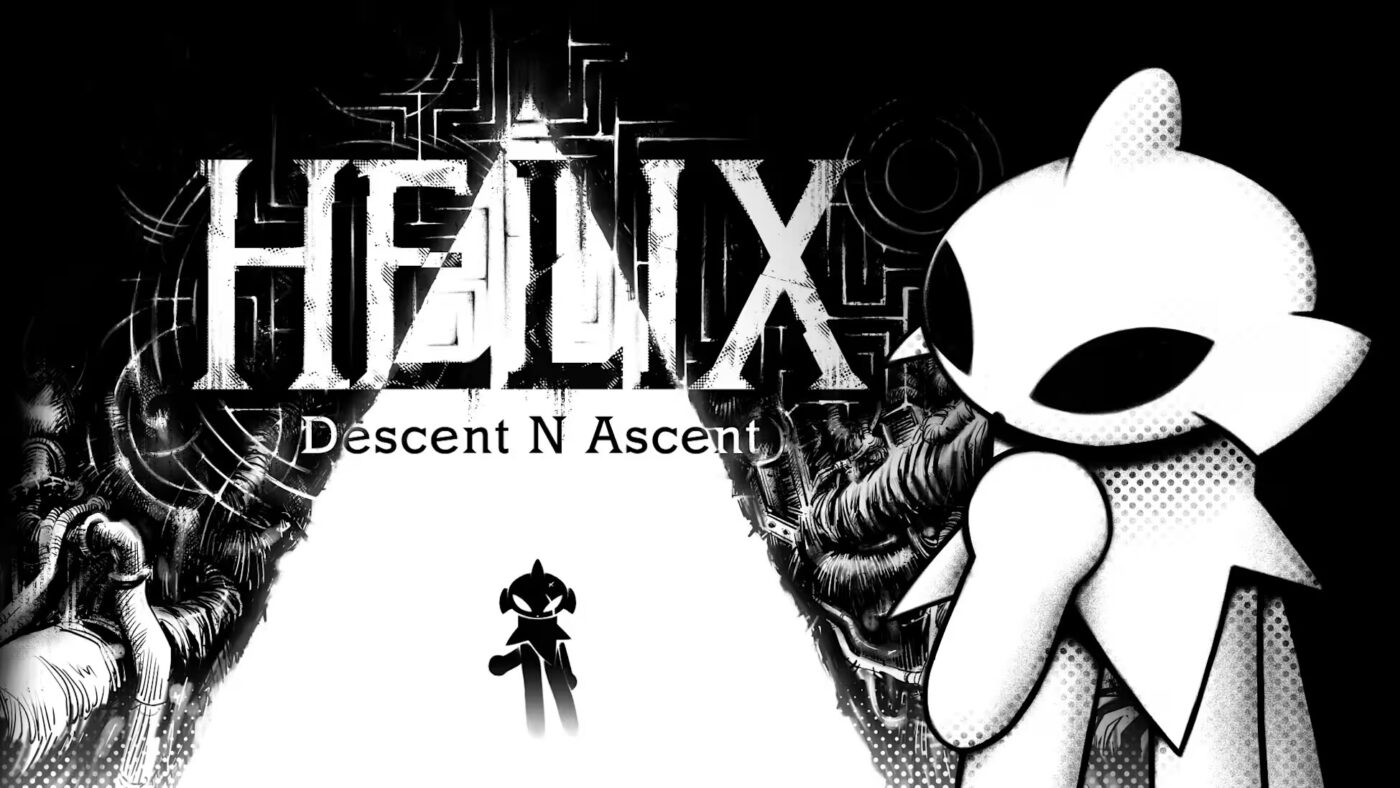
Badass Mongoose is a Belgian studio that, until very recently, no one had much reference for. Helix: Descent N Ascent is his first production, and from the first minute it is clear that it is not a timid debut: it is a platform puzzle wrapped in a black and white artistic direction so striking that at times it makes us forget that, beneath that surface, there is a system of combinable skills much deeper than what one would expect from a debut film.
Waking up without a name, without memories and without company
The premise starts in the most stripped-down way possible: we play a creature with elongated limbs and an almost alien appearance that wakes up alone in a dark, silent and apparently uninhabited world. There are no dialogues that explain who we are or what we are looking for, and this total absence of explanatory text is maintained throughout the adventure, forcing us to interpret each symbol of the environment, each fragment of ruined scenery and each object found as another clue to a story that is never told in words. Very soon in the journey a second character appears: a double almost identical to us, although with inverted colors, who constantly crosses the path without leaving it entirely clear whether he seeks to help or hinder progress. That ambiguity, sustained for a good part of the game, ended up being for me one of the most effective narrative hooks of the entire adventure, and the true emotional engine behind a world that, at first, feels completely empty of life.
The environment that surrounds this pair of opposites does not help to dispel doubts either: between the collapsed masonry and the almost desert landscapes, flickering monitors and arcade machines appear in a curiously perfect state of conservation, a contrast that suggests the remains of a civilization much more advanced than what the ruined environment suggests at first glance. The game never rushes to explain this contradiction, and prefers that it be the player himself who constructs his own reading of what this place was and what led this solitary figure there. It is a risky narrative decision, but one that particularly captivated me from the first moment, because each new symbol found feels like a genuine piece of a larger puzzle, and not like a simple visual decoration.
A system of skills that multiplies by combining
At the playable level, Helix: Descent N Ascent is built around a handful of skills that are unlocked as you progress, and that function as pieces of the same modular system rather than as isolated tools. The game features five main abilities in its first hours: a summonable block, a link hook, a drone, a kind of capsule for capturing creatures, and an inverter capable of altering the world itself. Each of them solves, separately, a type of specific obstacle, but their true potential only appears when they are combined with each other: the same block that serves to activate a floor switch can become a floating platform on the water, or an anchor point once the hook is unlocked, generating solutions that rarely feel repeated. The game itself promises 25 different ways to combine these skills spread across three levels of complexity, and playing it from start to finish I can confirm that that promise is fulfilled: the difficulty curve adds layers without depending on completely new mechanics all the time, something that is greatly appreciated in a genre where it is easy to fall into the recipe of simply accumulating tools without delving into any of them.
The general structure of the map follows a logic of an interconnected world that is quite common within the metroidvania genre, although applied with a slower pace: areas that seem closed on a first tour open up again later thanks to a newly acquired skill, pushing you to revisit already known spaces in a new light. Not everything works with the same precision in that regard: there are certain accesses hidden among the details of the scenario that I had a hard time identifying with the naked eye, and in some sections I ended up turning exploring the central map into a trial and error exercise much less satisfactory than solving the puzzles themselves within each room.
A motion comic made into a video game
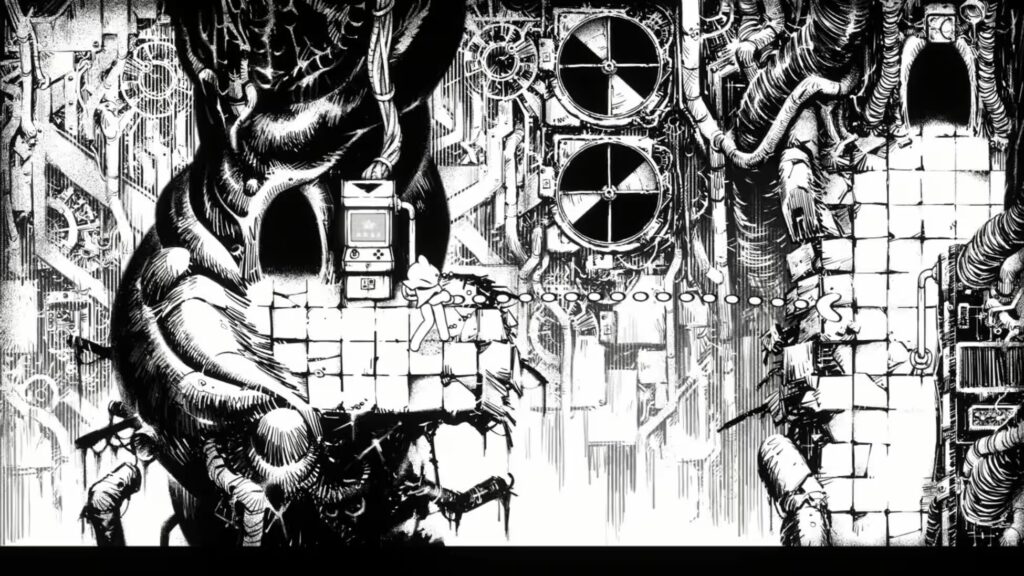
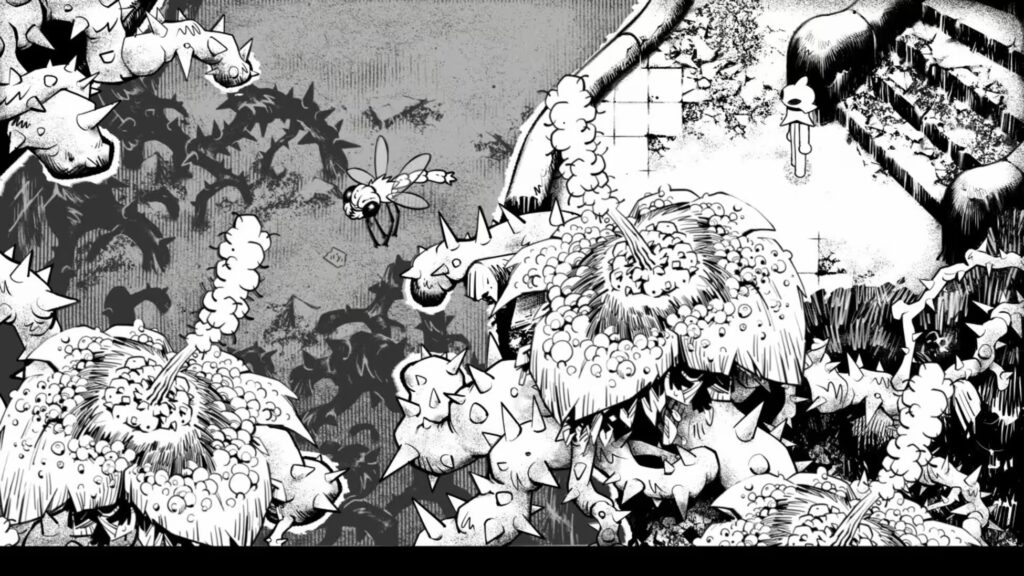
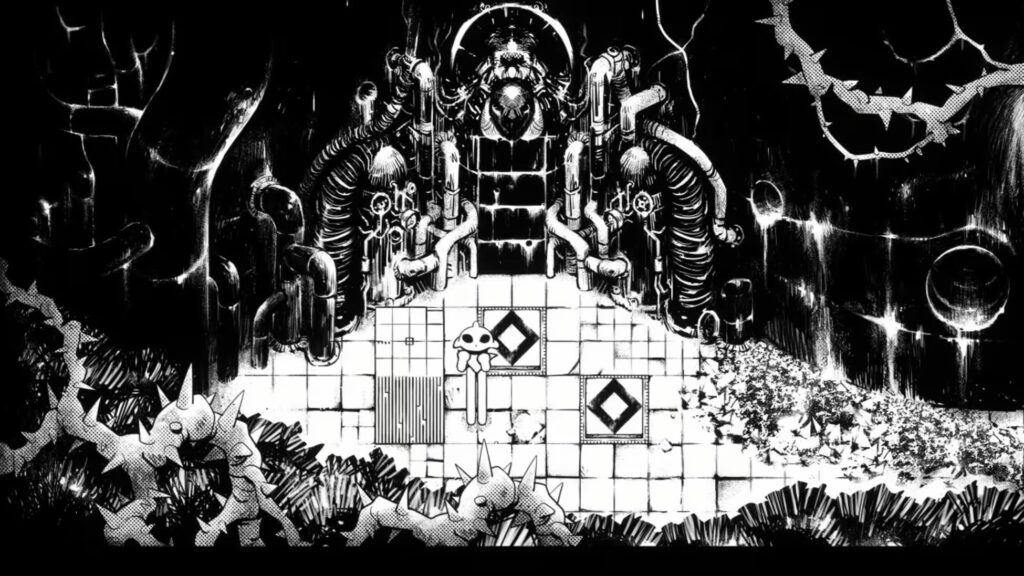
If there is one aspect of Helix: Descent N Ascent that seems directly indisputable to me, it is its visual section. The entire game is built based on a hand-drawn monochrome aesthetic, with 2D scenarios that combine fully illustrated areas with others that dissolve into sketch lines and blank spaces, as if it were a still unfinished drawing. The studio itself openly acknowledged its references to build that identity: the black and white independent comic of the 80s, the manga of the 90s, and the Franco-Belgian comic tradition of the 70s, an unusual mix that ends up giving Helix a visual texture that feels both classic and completely its own. The symbolic use of black and white is not limited to aesthetics: the duality between light and darkness runs through a good part of the game's silent narrative, even reinforced by the explicit appearance of a yin and yang symbol at some point in the adventure, in case it was necessary to emphasize that central idea even more.
The sound accompanies this proposal with an atmospheric soundtrack that never seeks to impose itself over the experience, but rather to sustain the contemplative tone of each scenario, something perfectly consistent with an adventure that privileges observation and patience over any type of playable urgency.
What is left hanging around after finishing it
Beyond the visual packaging, Helix: Descent N Ascent aims to talk about themes much larger than the simple resolution of puzzles: identity, loneliness and the ambiguous link between two opposing versions of the same existence. For me, that narrative ambition is both the game's greatest virtue and its greatest risk. The first half of the adventure strikes a remarkable balance between constantly introducing new ideas and a genuinely evocative atmosphere, and that was easily the part I enjoyed the most. Towards the final stretch, however, I felt that initial momentum beginning to lose some cohesion, with revelations that felt a little more spread out than the rest of the journey. Even so, the fact that the game relies so much on the intelligence of the player, without over-explaining or paving the way with objective markers, makes each solved puzzle feel genuinely earned, and that weighs heavily when it comes to evaluating it as a whole.
With an affordable launch price and available on both PC and Nintendo Switch, Helix: Descent N Ascent is one of those proposals that should be approached knowing well what type of experience you are looking for: there is no combat, there is no urgency, and a good part of the enjoyment depends on the willingness to sit and observe rather than react. For those who value that type of slow pace, wrapped in one of the most personal artistic directions that I have seen in a puzzle this year, Badass Mongoose delivers a debut that, although it does not manage to sustain all its ambition from start to finish, makes it quite clear that there is a studio with its own voice behind it.
Related Articles
![[Analysis] Escape from Umbra: A flashlight, a black cat and an Andalusian town that doesn't want to let you go](https://combogamer.com/wp-content/uploads/2026/07/escape-from-umbra-poster-300x169.jpeg)
![[Very Top] Six Super Smash Bros. Ultimate characters that I'm trying to master this summer](https://combogamer.com/wp-content/uploads/2026/07/Muy-Top-Smash-Bros-Ultimate-3-300x300.jpg)
![[Analysis] The robot anime that never existed comes to life thanks to Geppy-X](https://combogamer.com/wp-content/uploads/2026/07/geppy-x-poster-300x169.jpg)
![[Analysis] Denshattack!: A train that does tricks like a skateboard in a dystopian Japan](https://combogamer.com/wp-content/uploads/2026/03/Denshattack_poster-300x169.jpg)
![[Analysis] Celestial Return: Losing the dice is also losing the game](https://combogamer.com/wp-content/uploads/2026/07/celestialreturn_keyart-300x182.jpg)
![[Analysis] Mixtape: the narrative adventure that turns a 90s mixtape into an unforgettable video game](https://combogamer.com/wp-content/uploads/2026/07/mixtape-poster-300x160.png)