

Table of Contents
During recent history, there has not been a figure more parodied than that of the father of the family. It is not surprising, since it constitutes one of the most everyday archetypes, something in which the vast majority can see themselves reflected. In the end, the most classic nuclear family (father, mother and children) continues to be one of the fundamental groups in which society is structured, despite the changes that have been introduced (although, yes, more in form than in substance). Thus, in a large part of the situation comedies, which have the United States as their nerve center, the figure of the father is often treated in a jocular way. There are even series that have their leimotiv in it, such as The Simpsons, or even more clearly, Family Guy (Family Guy) and Father Made in USA (American Dad).
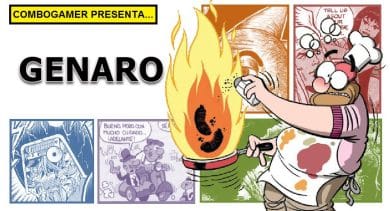
Limiting our attention to the world of comics, and more specifically to those of national production, we have the examples of families and parents of Bruguera (or his ersatz uncle, either as an easy resource or as a result of censorship in the face of alleged attacks against the institution of marriage) that I already discussed in passing in the articleDon Pio, but we also have more current examples. Such is the case of Genaro: the ember at home, a series of comic strips drawn by Mel for the magazine Thursday, whose eponymous protagonist will be our character today.
A traditional and folksy guy
If one had to define Genaro in a few words, one could say that he is a kind of Spanish Homer Simpson, between ten and fifteen years older than him, with much “grown up” children (the two he has are in their twenties) and with a worse marriage. This is a man now entered his fifties, bald, somewhat chubby, with a brown beard of several days and what appear to be a few glasses that blend in with some large and expressive eyes. Some that grew over time in an inverse proportion to the his nose, which went from an eggplant shape to being relatively small and upturned.
![[Meeting…] Genaro](https://combogamer.com/wp-content/uploads/2015/12/Genaro-intelectual.jpg)
Genaro is an old-fashioned man, and often tends to embarrass his wife and children with his occasional outings. get used to spend long periods of time on the couch watching football games, or in the bar counter drinking and eating tapas with his friend Paco, with whom he also dedicates himself to giving compliments of dubious taste to the young girls they meet. However, it seems to have a militant past during the turbulent period of late Francoism and the early stages of the constitutional era, although it would later be revealed that he only did so to be able to flirt with Teresa, his wife.
![[Meeting…] Genaro](https://combogamer.com/wp-content/uploads/2015/12/Genaro-antes-y-despues.jpg)
Although I have compared him to Homer Simpson, it would be more appropriate to do so with that of the early stages, those of the naive and simple-minded Homer who, however, does not reach the levels of profound subnormality of his more recent versions, although he can reach considerable degrees of stupidity in certain strips.
![[Meeting…] Genaro](https://combogamer.com/wp-content/uploads/2015/12/Genaro-y-su-mujer.jpg)
From generation to generation
As I already indicated in the introduction, the series has family relationships as its central axis, in addition to playing in one way or another many other current issues. His own name, Genaro (which arose from an association of ideas regarding what was going to be the title of the series, Degeneration to generation), suggested where it was going to have the most impact. Indeed, The generational gap is one of the most recurring themes. Initially, Genaro was a divorced father who had to deal with his two children, and whose conflicts they triggered were the excuse from which the gags were unleashed. These are Jero, quien aúna en un solo personaje ciertos tópicos del perroflauta (rastas, piercing, afición por la marihuana, etc.) y el geek (cómics, videjuegos y una vida sexual prácticamente inexistente), así como ciertos males que asolan a la juventud española como el desempleo y la nula autonomía; y Gema, que se caracteriza por hacer del carpe diem su modo de vida en lo referente a su afición por las fiestas y el carácter liberal de sus relaciones amorosas (es muy frecuente que sus gags de desarrollen antes, durante o después del acto), que va en paralelo con un acusado rechazo por todo lo que huela a relación estable. Cuando Genaro se reconcilie con su mujer (tras una serie de hilarantes lances y altibajos, eso sí), estas situaciones pasaron a compartir protagonismo con los tiras y aflojas de la vida conyugal.
![[Meeting…] Genaro](https://combogamer.com/wp-content/uploads/2015/12/Genaro-hijos.jpg)
Fuera de la familia, y en lo que atañe a otros temas cotidianos y de actualidad, también predomina el conflicto generacional. Así lo ponen de relieve situaciones como la crisis de los cincuenta, sus problemas en la oficina al ser el más veterano de la empresa al estar “rodeado de becarios y pipiolos”, o su eterna lucha con las nuevas tecnologías. Tampoco se escatima en los numerosos chascarrillos costumbristas en los que Genaro, su familia y/o su amigo Paco son los protagonistas.
![[Meeting…] Genaro](https://combogamer.com/wp-content/uploads/2015/12/Genaro-y-sus-companeros.jpg)
Conclusion and recommendations
Genaro es un padre de familia rechoncho y cincuentón cuyo carácter castizo, algo retrógrado y simplón choca de frente con varios aspectos de la vida moderna que encarnan sus hijos, su jefe y sus compañeros de trabajo. Su turbulenta vida conyugal es otro de sus frentes abiertos que tampoco le dará tregua.
El mercado de segunda mano es la única vía para hacerse con alguno de los tomos que recopilan las tiras deGenaro: the ember at home, puesto que la mayoría son suplementos que salieron al mercado como suplementos de determinados números de El jueves, y aquellos (o para ser más exactos, aquel) que fueron distribuidos como ejemplares de librería se encuentran descatalogados. Los que corresponden al primer grupo son La brasa en casa (2007), Grandes ratitos (2009) and Familia real (2011), mientras que en el segundo grupo tenemos Fotos de familia (2008), publicado por Ediciones El Jueves en tapa dura.
![[Meeting…] Genaro](https://combogamer.com/wp-content/uploads/2015/12/Genaro-grandes-ratitos.jpg)
![[Meeting…] Genaro](https://combogamer.com/wp-content/uploads/2015/12/Genaro-fotos-de-familia.jpg)
Y como guinda del pastel, os dejamos con un dibujo de Olga Cruz, nuestra nueva colaboradora, quien a partir de ahora nos honrará con algún dibujo del personaje tratado, ya sea solo o en compañía de otros anteriormente expuestos. ¡Bienvenida!
![[Meeting…] Genaro](https://combogamer.com/wp-content/uploads/2015/12/Genaro-Olga.jpg)
Related Articles
![[Review] Planeta Manga and MANGA ISSHO: Spanish and European manga magazines](https://combogamer.com/wp-content/uploads/2026/06/Planeta-Manga-ISSHO-manga-300x169.png)
![[Review] Mazinger-Z: The Robot of the Stars – The Spanish comic that improved the Taiwanese nonsense on which it was based](https://combogamer.com/wp-content/uploads/2025/08/Mazinger-Z-el-robot-de-las-estrellas-300x198.png)
![[Meeting…] Midna: the Twilight Princess, with more contrasts than ever](https://combogamer.com/wp-content/uploads/2025/05/Conociendo-a-Midna-300x146.png)
![[Article] The "comics of the year" (2024 special)](https://combogamer.com/wp-content/uploads/2025/01/Los-comics-del-ano-2024-1-300x169.jpg)
![[Review] Brian the Brain Integral](https://combogamer.com/wp-content/uploads/2024/11/Brian-the-Brain-Integral-Resena-300x179.png)
![[Very Top] Five graphic novels by Paco Roca](https://combogamer.com/wp-content/uploads/2024/09/Muy-Top-Paco-Roca-Portada-300x248.jpg)