
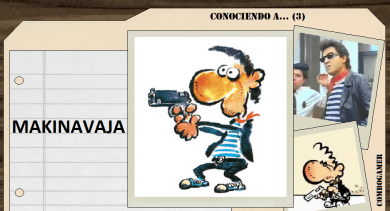

Ramón Tosas Fuentes (better known as Ivà) was one of the most influential and fun cartoonists in Spanish comics in the period from the mid-eighties to the early 90s.
Stories of Puta Mili and Makinavaja, the last sausage They are his two most popular works, as they represented an entire generation in their own way and won the applause and favor of the public thanks to their atypical language and lack of political correctness.
On this occasion I am going to talk about Makinavaja, an endearing and funny character who was for years the most famous of Thursday, the magazine where he was born.
The last choriso, the last prophet
Makinavaja (or Maki) is a criminal raised on the streets of Barcelona's Chinatown. The son of a prostitute and (supposedly) a law enforcement officer, he turned mischief and crime into his profession.
Maki has an unmistakable appearance, his toupee, his scar on his eye and his classic clothing, usually composed of jeans, a striped T-shirt, a leather jacket and a red scarf around his neck, make him stand out from the rest of the people. Due to his long history as a criminal, he has a certain reputation (positive or negative, depending on how you look at it) in his neighborhood and surrounding areas.
![[Meeting…] Makinavaja](https://combogamer.com/wp-content/uploads/2017/09/Makinavaja-catalan.png)
Despite having no qualms about stealing and even killing, Maki is usually considered a good guy, since despite his profession he is not particularly violent or sadistic, and on certain occasions he usually does acts of justice (in his own way) and he does not like to be cruel to the victims of his robberies. Although it is true that he does not hesitate to shoot in cold blood if he is angered (for example, if someone messes with Frank Sinatra, his favorite singer), Maki is usually quite calm, to the point that it is common to see him philosophizing about life and his circumstances, releasing some phrases that his companions rarely understand or share and that, in their own way, are truths like fists.
![[Meeting…] Makinavaja](https://combogamer.com/wp-content/uploads/2017/09/Makinavaja-autodestruccion-1024x309.png)
Because he was born in a working-class neighborhood and is from the lower class, Maki tends to have some sympathy towards the political left (he is quite anarchic in general) although it cannot be said that he is a character with political militancy or history, since in general he does not usually get involved in those issues officially.
Despite moving like a fish through water in his neighborhood and controlling his work quite well, it is inevitable that time changes society and introduces new things even in disadvantaged areas. At the beginning of the series, Maki leaves prison and sees a world that has changed too quickly and that feeling will remain throughout the series, since both Maki and his companions are becoming obsolete, hence the nickname "the last choriso" in his comics.
![[Meeting…] Makinavaja](https://combogamer.com/wp-content/uploads/2017/09/Makinavaja-primera-aparicion.png)
![[Meeting…] Makinavaja](https://combogamer.com/wp-content/uploads/2017/09/Makinavaja-jueves-somos-peligrosos.jpg)
![[Meeting…] Makinavaja](https://combogamer.com/wp-content/uploads/2017/09/Makinavaja-jueves-san-peo.jpg)
We are dangerous
Makinavaja makes a living by robbing banks or people, a risky but generally lucrative job (depending on where or who you rob). In his professional and personal career, Maki has made a large number of friends, acquaintances and associates.
Popeye (Popi): Makinavaja's faithful companion, he is short, a little chubby and somewhat innocent. He is Maki's childhood friend. Together they robbed tobacco shops and pharmacies to obtain their first income.
![[Meeting…] Makinavaja](https://combogamer.com/wp-content/uploads/2017/09/Makinavaja-popeye-1024x589.jpg)
Mustafá (also known as Mojamé or Moromierda): Maki's Moroccan companion, he usually has businesses in parallel with his companions, such as theft of televisions or even arms trafficking, tasks that he carries out in collaboration with the Pirate.
![[Meeting…] Makinavaja](https://combogamer.com/wp-content/uploads/2017/09/Makinavaja-Moro-atraco.jpg)
Pirate (Pira): owner of the Pirate Bar, where the aforementioned characters meet. His bar is often used as a clandestine warehouse for drugs, weapons, stolen items and even a hostage or corpse.
Other characters that hang around the pirate bar are usually the elderly criminal, Matias (Agüelo) and Makinavaja's nephew (Pitufo) or mother (La Maru), as well as other criminals and residents of Chinatown.
![[Meeting…] Makinavaja](https://combogamer.com/wp-content/uploads/2017/09/Makinavaja-personajes.jpg)
The particular job of Maki and his companions will lead them to encounter the police more than once, especially with Commissioner Mediaostia, who usually has a quite strong temperament and does not hesitate to resort to violence when doing his job. The relationship between Mediaostia and the group of criminals is so common that sometimes they even treat each other with a certain camaraderie (within limits).
All of these characters usually speak with expressions and poorly pronounced words that are generally seen in the common vocabulary of marginal areas, so it is common to see expressions like “Po bien, po fale, po malegro”, “cangon San Peo” or words like “pulisia”.
![[Meeting…] Makinavaja](https://combogamer.com/wp-content/uploads/2017/09/Makinavaja-jueves-sin-dios-ni-amo-824x1024.jpg)
![[Meeting…] Makinavaja](https://combogamer.com/wp-content/uploads/2017/09/Makinavaja-jueves-curas.jpg)
Conclusion and Recommendations
Makinavaja is a criminal, but he is tremendously charismatic and funny, in addition to being half philosopher and, in his own way, half vigilante. Despite committing crimes and even murders, it shows us how violent society is in various areas of large cities. Furthermore, their adventures show that not everything is black and white, nor are they so bad, nor are the police so good, nor is society so just, nor is politically correct so necessary.
The curious thing about Makinavaja's adventures is that They are based on the personal experience of their author, who lived on the Ramblas of Barcelona for many years, sharing a neighborhood with petty criminals, dealers and prostitutes who were regular neighbors in some areas. The philosophy and cynicism of the characters also come from the personality of Ivà himself.
![[Meeting…] Makinavaja](https://combogamer.com/wp-content/uploads/2017/09/Makinavaja-tiroteo.jpg)
In a way, Makinavaja represents a bygone era, not only because of the type of characters in its stories, but also because of the type of situations that were represented, which today would be tremendously controversial and could even be banned due to their lack of political correctness. In Maki's own words, the only thing that has not changed in society are the shitty salaries and with that phrase alone you can see how right he is.
![[Meeting…] Makinavaja](https://combogamer.com/wp-content/uploads/2017/09/Makinavaja-obreros-1024x567.jpg)
Makinavaja was a very popular character in the early 90s, so he was lucky to be well treated in the domestic market. His appearance in the magazine Thursday For decades it generated a lot of material that has been compiled on several occasions by the magazine itself during the decade. It is common to find “El Maki” in the collection Banners of Humor and in El Jueves Luxury Gold Collection. There are also some compilations edited by Dolmen Editorial, where the stories of this character in his various stages are collected.
![[Meeting…] Makinavaja](https://combogamer.com/wp-content/uploads/2017/09/Makinavaja-jueves-GOLD.jpg)
![[Meeting…] Makinavaja](https://combogamer.com/wp-content/uploads/2017/09/Makinavaja-Dolmen-3-744x1024.jpg)
La popularidad de este personaje fue tal que se hizo una obra de teatro contando sus aventuras en 1989. Poco después multiplicó su fama cuando dio el salto a la gran pantalla con dos películas protagonizadas por Andrés Pajares: Makinavaja, el último choriso (1992) y su secuela Semos peligrosos – uséase Makinavaja 2- (1993).
![[Meeting…] Makinavaja](https://combogamer.com/wp-content/uploads/2017/09/Makinavaja-pelicula.jpg)
Además, en 1995 se hizo una serie para televisión del personaje llamada simplemente Makinavaja que contó con dos temporadas y un total de 39 episodios. Algunos de los actores de las películas regresaron para hacer el mismo papel en la serie, aunque el personaje de Makinavaja lo interpretó Pepe Rubianes en lugar de Andrés Pajares (quien por aquel entonces se encontraba rodando otra serie).
![[Meeting…] Makinavaja](https://combogamer.com/wp-content/uploads/2017/09/Makinavaja-dicho.jpg)
Tanto las películas como la serie de televisión basan sus guiones en los cómics originales, suavizando algunas escenas para que no fuesen demasiado violentas, representando de manera bastante fidedigna a este popular personaje.
Related Articles
![[Review] Planeta Manga and MANGA ISSHO: Spanish and European manga magazines](https://combogamer.com/wp-content/uploads/2026/06/Planeta-Manga-ISSHO-manga-300x169.png)
![[Review] Mazinger-Z: The Robot of the Stars – The Spanish comic that improved the Taiwanese nonsense on which it was based](https://combogamer.com/wp-content/uploads/2025/08/Mazinger-Z-el-robot-de-las-estrellas-300x198.png)
![[Meeting…] Midna: the Twilight Princess, with more contrasts than ever](https://combogamer.com/wp-content/uploads/2025/05/Conociendo-a-Midna-300x146.png)
![[Article] The "comics of the year" (2024 special)](https://combogamer.com/wp-content/uploads/2025/01/Los-comics-del-ano-2024-1-300x169.jpg)
![[Review] Brian the Brain Integral](https://combogamer.com/wp-content/uploads/2024/11/Brian-the-Brain-Integral-Resena-300x179.png)
![[Very Top] Five graphic novels by Paco Roca](https://combogamer.com/wp-content/uploads/2024/09/Muy-Top-Paco-Roca-Portada-300x248.jpg)