
Table of Contents
The Rabbit R1, that compact pocket-sized AI device that debuted in 2024 with a retro-futuristic design and a focus on vocal commands, always promised to be a revolution in everyday interaction with artificial intelligence. HisLarge Action Model(LAM) allowed tasks like ordering a taxi or selecting music without intermediate apps, but the original software felt a bit crude, with an over-reliance on voice that complicated its use in discrete environments. Now, with rabbitOS 2 released in September 2025 after more than 30 over-the-air updates in 16 months, the R1 is undergoing a complete metamorphosis. This version not only polishes the technical rough edges, but elevates it to a versatile multimodal companion, where voice, touch and vision merge into a fluid and addictive experience, ideal for creators and professionals on the go.
And hey, if you think AI is only for advanced things, let me tell you, there's nothing easier than using the Rabbit R1 for fun or even for basic queries. I use it all the time. Every time I have a question, I ask and that's it. And if I don't have it with me, I set a reminder on my phone to ask Rabbit when I get home. I also ask him a lot about topics that come up when I'm playing a video game, ranging from the historical context to how many endings the game has or how to unlock or get an item.
Multimodal Interface: From Voice to a Natural Touch Flow
At the heart of rabbitOS 2 beats a dynamic card-based interface, a “Card Stack» that deploys key functions with a simpleswipeup from the home screen. Imagine accessing the Magic Gallery to edit photos with AI or the Rabbit Hole to view your smart journal entries, all with intuitive touches and haptic feedback that responds instantly.
The original system confined navigation to the scroll wheel and verbal commands, leading to awkward pauses in noisy or private settings. Now, gestures like swiping down for quick brightness and volume adjustments, or long taps to personalize cards, turn the R1 into something that feels like a distilled smartphone, but without the distractions of notifications. This evolution reduces latency by 30-40%, thanks to optimizations in the LAM's edge processing, making each interaction predictive and ergonomic, with MediaTek hardware shining in efficiency.
The wheel, that iconic element, is not far behind: it now acts as a complementary analog selector, allowing you to flip through cards like aRolodexdigital while the touch screen handles the fine details. In daily tests, this multimodality transforms usage sessions from frustrating minutes to flowingseamless, where breaks for corrections become creative opportunities. The result is a device that anticipates needs, such as displaying real-time transcripts during a vocal conversation, eliminating the opacity of OS1 and encouraging usability that adapts to your pace, whether in a meeting or a casual walk.
Offline Processing and Autonomy: Freedom Without Connections
One of the most notable shortcomings of the original Rabbit R1 was its reliance on the cloud for essential tasks, making it vulnerable in low signal areas or travel.offline.rabbitOS 2 fixes this with robust edge computing that enables local AI voice transcriptions and summaries, achieving 95% accuracy in noisy environments without a byte of external data. Record a memo on a crowded subway, and the device processes it instantly, storing it in the Rabbit Hole for later syncing. This autonomy not only instills confidence, but extends the battery by 20% during mixed sessions, thanks to low-power algorithms that prioritize on-device processing.
Compared to the OS1, where recordings were often truncated or lost nuances without internet, this improvement makes the R1 a genuine smart pocket recorder. Exporting Magic Camera photos, both original and AI-edited, integrates directly into the cloud-based journal, eliminating tedious manual transfers. In an increasingly disconnected world, this offline capability positions the R1 as a reliable ally for digital nomads, where AI doesn't wait for Wi-Fi to shine.
Creations: The Art of Vibe Coding on Your Palm
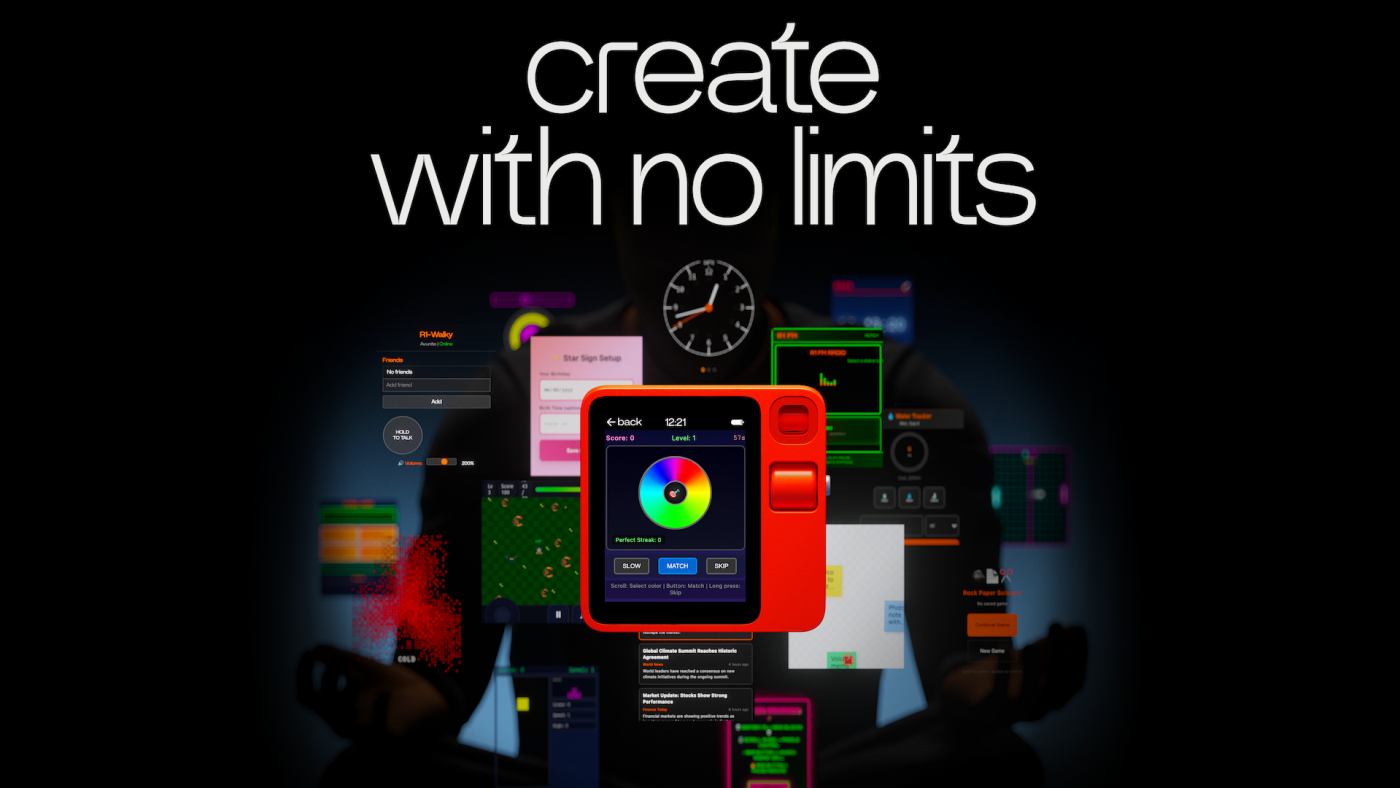
If rabbitOS 2 redefines usability, “Creations” reinvents it completely, making Rabbit R1 the first “vibe coding” platform accessible to everyone. Powered by Rabbit Intern, a generalist AI agent, this feature allows you to describe ideas verbally – such as “create a chess game with wheel controls and sound effects” – and see how the LAM iterates in real time, clarifying details and deploying the app in minutes, all on the device itself and with zero latencies. The original limited the AI to predefined actions; Now, it generates custom interfaces, voices and tools without manual code, opening a community ecosystem where you can download creations via QR from rabbit.tech and also share yours.
Technically, this leverages advances in agentic models for autonomous feedback loops, integrating image generation for rich visual elements. Users have already created everything from themed puzzles to universal musical tuners, forming a living repository of free innovations. This creative freedom, with scalable builds and support for contextual follow-ups, transforms R1 from passive executor to proactive co-creator, where the barrier to entry is only your imagination.
As an example of the above, see the curated list of creations on the website itself.rabbit creations.
Privacy and Performance Improvements: Details That Add Up to Big Wins
rabbitOS 2 doesn't forget the fine touches: live translations now include synchronized transcriptions for fluid multilanguage, and a bottom touch button simplifies mute/unmute, addressing OS1 privacy concerns in shared spaces. The Rabbit Hole retains conversational threads without repetitive recaps, while gesture integration expands control to fast motion or volume adjustments. In performance, refinements to the LAM cut voice errors and optimize resources, making responses 20% faster on this compact 115 gram hardware.
These fixes and improvements elevate the overall experience, where the R1 feels renewed: from a novel gadget to a mature and fun one. Compared to the original, rabbitOS 2 does not patch; redefines, going from reactive to collaborative, with an ecosystem that grows organically thanks to the community.
In short, the Rabbit R1 with rabbitOS 2 encapsulates the future of wearable AI: extreme portability, a focus on distraction-free creation, and a learning curve that encourages experimentation. By 2025, it is more than a device; It is a catalyst for ideas, perfect for those looking for tools that amplify daily intuition. If you haven't tried it yet, thisupdatemakes it irresistible – the old R1 is gone, and in its place is something truly magical.
Related Articles